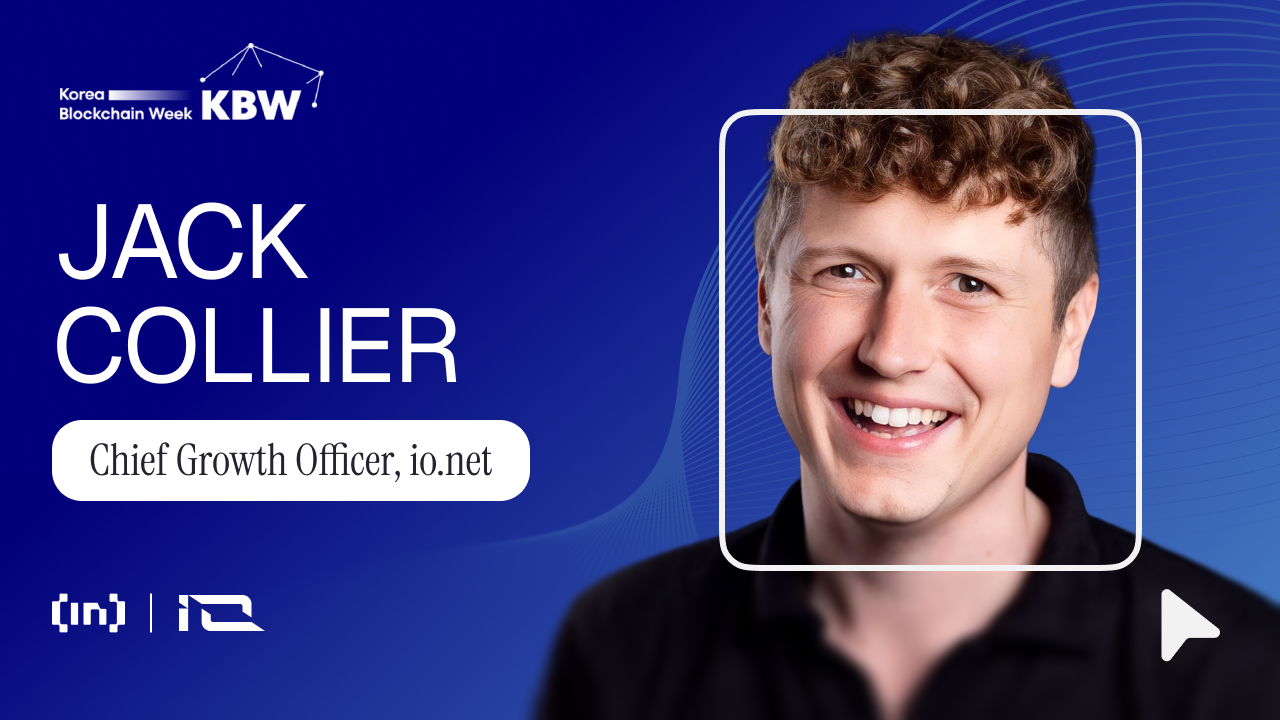
Jack Collier has carved a unique path through the crypto industry. The Chief Growth Officer of IO.net brings experience from Circle and Near Protocol. This marks his third venture into blockchain technology, each role deepening his conviction about decentralization’s potential.
Speaking at Korea Blockchain Week’s main event venue, Collier emphasized what sets IO.net apart. Unlike many Web3 projects that promise future utility, IO.net delivers tangible value today. The platform connects available GPU resources globally, creating a decentralized compute network that’s already serving enterprises.
What initially attracted you to IO.net, and how does decentralized compute differ from other blockchain applications you’ve worked with?Sponsored
Sponsored

“What drew me to IO specifically was decentralized compute. In blockchain, it actually has a real use case today – it makes sense, it’s not an abstract idea. People can put their own supply onto a network, whether that’s data centers or yourself with your laptop, contributing your available GPU power, and getting fairly compensated for it using tokenomics. My background is in growth and marketing, and I really wanted to take that message and bring it to a broader market. Where Web3 really suffers today is there’s often a lot of talk and promises, but very few verticals actually deliver. My philosophy was: let’s start at the bottom with compute and go up the stack as we grow.”
IO.net reported strong revenue growth in the last quarter despite a challenging crypto market. Which partnerships or technology developments contributed most significantly to this achievement?
“When we first launched, our main market was Web3 projects, but we’ve been trying to market to Web2 businesses, ordinary startups, and ordinary enterprises over the last six to twelve months. Most of our revenue growth has been driven from that segment. We work with Leonardo.ai, which is now part of Canva, and they’ve saved significantly on their compute costs. UC Berkeley also uses our platform and has achieved substantial savings. We also work with Wandera.ai and Sahara AI for inference – they’re saving considerably from what they were using before, primarily because of the lower compute costs we can offer through our decentralized network.”
The IO Explorer shows utilization rates at around 50%. How does IO.net balance GPU supply and demand to maintain sustainable operations?
“We have to balance the amount of GPUs available to consumers. If we were at 100 percent utilization, there would be no access for new users. The GPUs are idle in the sense that they’re ready for somebody to come and purchase when they need to. What we do is as we see demand increase, supply increases as well. We have both of those functions in the business and we solve for both of them every day.”
IO.net recently launched IO Intelligence, its automated AI model deployment platform. How has this impacted enterprise adoption and developer engagement so far?
“One of the biggest problems that developers face when they’re trying to get involved in AI is they’re often having to use a disparate set of tools. They need a compute provider, they need to select an open source model, they need a RAG service to give it context, and an orchestration platform. They’re paying subscriptions for each service, and they often don’t integrate with each other. What we’re trying to do with IO Intelligence is build an open source infrastructure layer that has all those pieces together. A developer can come on a single platform and do all the tasks they need. If you want to just play around and use it like ChatGPT today, you get 500,000 free tokens every day.”
With IO.net’s pivot toward VMaaS (Virtual Machine as a Service), what are the strategic reasons behind this approach and how does it complement the existing infrastructure?Sponsored
Sponsored
“I wouldn’t call it a pivot. When people need compute, they can get bare metal – that’s just the chipset with nothing pre-installed. But a lot of people need a pre-installed layer on top. A virtual machine is like installing Windows on a Mac, so you can run it alongside the existing system without changing the underlying hardware. You install a pre-installed operating system on the chip. We’re just giving people more flexibility in how they can interact with the chip. It’s complementary to all the other layers – containers, bare metal, Ray – so you can interact with the GPU on your terms.”
How does IO.net address the challenges of ensuring reliable uptime and performance across a highly decentralized pool of GPUs, especially when dealing with enterprise clients?
“We use blockchain to verify and secure supply. When you put your supplier on the network, you must stake IO tokens to validate your chipsets’ performance claims. This applies whether you’re a community member with a single machine or a data center. The system includes a built-in disincentive mechanism. If your device doesn’t perform as stated, the network can slash your stake. There’s a disincentive mechanism built in – if your device doesn’t do what it stated it would do, then the stake can be slashed. This gives consumers confidence that what they’re renting actually meets the requirements and standards.
You can validate the supply, check how reliable that supply’s uptime has been, and see the supplier’s history. This differs greatly from centralized providers like AWS. With AWS, nothing happens if they don’t live up to their claims. On our network, you can literally see what happens on an open network.”
Given the global nature of GPU providers and blockchain payments, how is IO.net preparing for potential regulatory and data sovereignty challenges?
“We work with local suppliers across regions. If I’m in the US and want to make sure that my machine is in the US for data compliance needs, I can come onto the platform today and secure a GPU that’s in the US, which I know is in the US – verified on chain. I know the way I’m interacting with that is compliant from a SOC 2 perspective because we’re a SOC 2 compliant organization. The data won’t go outside of that region, and it’s traceable on chain. From the supply side, we have a supply team that works with suppliers to make sure local and regional regulations are complied with.”
The recent token unlock event raised concerns about market volatility. How is IO.net managing tokenomics and community confidence to ensure sustainable growth?
“We use emissions from the token to incentivize suppliers to join our network. We’re always looking at our tokenomics design – not necessarily how things are emitted, but how the token is used to power the network. We’re always looking at that to make sure it incentivizes suppliers in the right way and provides utility to users. It’s something we’re actively exploring to make it as efficient as possible.
Web3 technologies make the most sense when they have the ability to solve real world problems that can’t be solved through other solutions. The lack of access and prohibitive costs of compute for a large majority of global AI projects, is exactly one of those problems that Web3 can solve. That’s why I’m so excited to be on this journey with io.net.”