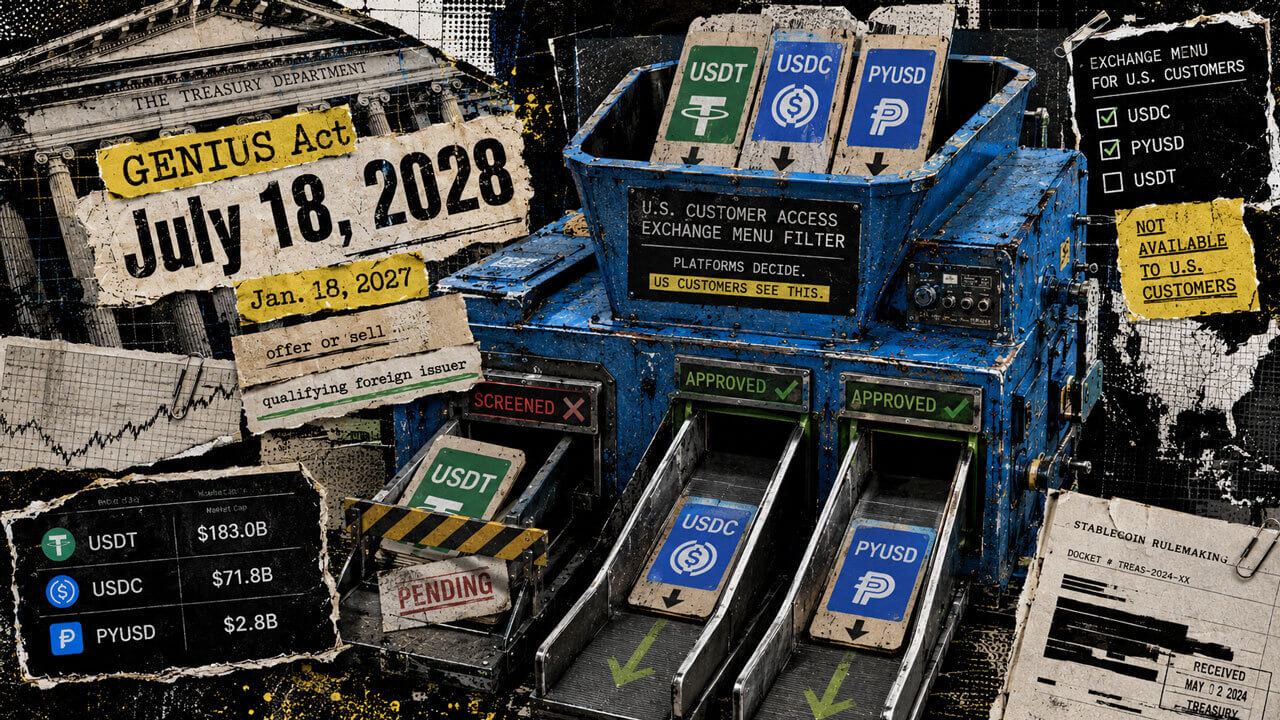
By July 18, 2028, a stablecoin could still move freely across blockchains and yet disappear from the buy menu on an American exchange. Under the Treasury Department’s proposed GENIUS Act rules, a digital asset service provider wouldn’t be able to offer or sell a payment stablecoin to someone in the United States from that date unless its issuer fits one of the law’s permitted categories.
The proposal doesn’t ban an offshore token from circulating abroad or moving between private wallets; it just controls how regulated businesses distribute that token inside the US. For Tether’s USDT, the biggest issue is therefore whether an American exchange can keep offering it to customers, even though the token itself would continue to exist and function on-chain.
That distinction is what turns GENIUS from an abstract licensing law into something users can actually see and interact with. Treasury expects the broader regime to take effect on Jan. 18, 2027, giving issuers and the platforms carrying their tokens 18 more months to prepare for the larger distribution restriction in 2028.
The exchange is now the border
The two dates divide implementation into stages. Starting Jan. 18, 2027, companies won’t be able to issue a payment stablecoin in the United States without entering the GENIUS regime. A US service provider carrying a foreign-issued token would also face initial conditions tied to the issuer’s ability and commitment to obey lawful orders and the relevant reciprocal arrangements. On July 18, 2028, the wider rule would take hold, and covered providers would only be able to carry tokens from permitted issuers or qualifying foreign issuers.

“Digital asset service provider” sounds like a narrow legal category, but it covers most of the businesses through which ordinary users buy and store crypto. Exchanges fall inside it, as do custodians and companies that transfer digital assets or provide certain services connected to their issuance. If one of those businesses serves US customers for profit, it may have to decide whether every single stablecoin on its platform has a valid route under GENIUS.
Treasury also gives “offer or sell” a much wider meaning. A platform can fall inside the rule by advertising a stablecoin, agreeing to sell it, or telling someone who contacted the company first that it is willing to complete the trade. Helping a customer get around geolocation controls can count as well. An exchange couldn’t necessarily defend a sale by saying that the buyer asked for the token without being prompted.
A centralized exchange already knows who opened an account and which country that account belongs to, while its app controls which assets a customer can buy. Custodians decide which tokens they will hold, and hosted wallets choose which purchase and swap routes they support. Treasury would use those existing controls to make the businesses closest to the customer check an issuer’s legal status.
For individuals, the location test is mainly physical. A US resident temporarily abroad would generally be treated as outside the country for a transaction conducted there. A non-US resident who is only visiting the United States receives a narrow exception in specified circumstances. The rule is aimed at the place where the service is actually delivered, so it doesn’t attach permanently to every wallet owned by an American.
Self-custody is outside much of this framework. The proposal excludes people sending stablecoins on their own behalf, direct peer-to-peer transfers, and software that simply helps someone hold their own assets. An American could therefore continue to possess an offshore token or receive one directly even if a regulated exchange could no longer sell it. The friction begins when that person tries to use a covered business to buy, swap, or deposit the token.
Treasury accepts that this approach can make the market more concentrated. Its proposal identifies switching costs and reduced consumer choice among the possible costs, and the agency rejected a wider temporary safe harbor for smaller foreign stablecoins. Faced with one token from a fully permitted US issuer and another that requires legal review, technical checks, and continuous monitoring, an exchange has a commercial reason to choose the easier listing.
When a stablecoin’s code becomes compliance evidence
Foreign issuers still have a route into the US market under Section 18 of GENIUS. Their home country must operate a stablecoin regime that Treasury considers comparable to the American one. The issuer must then register with the Office of the Comptroller of the Currency and show that it can comply with lawful US orders.
That last requirement is what actually brings the stablecoin’s code into the regulatory process. Treasury asks whether an exchange’s due diligence should include examining a foreign issuer’s smart contracts and confirming that it can seize, freeze, or burn tokens when legally required. These functions allow an issuer to block funds at a specific address or remove particular tokens from circulation.
Treasury is currently asking the public whether those technical checks should become part of the final rule, as it hasn’t yet ordered every platform to perform them. Even so, the proposal shows what an offshore issuer may have to prove. Reserve reports and redemption policies explain whether a token is financially backed, while smart-contract controls show whether its issuer can carry out a court order. Access to American exchanges could depend on both.
Tether is the best real-world example because USDT is issued outside the United States but is currently available to US customers through venues including Coinbase and Kraken, subject to each platform’s eligibility rules. Tether holds digital asset and stablecoin issuer licenses in El Salvador and has already demonstrated that it can freeze addresses while working with US authorities.
The company has also built a separate token for the domestic market. Tether launched USA₮ in January as a federally regulated dollar stablecoin and said USDT was progressing toward GENIUS compliance. It could seek qualifying foreign issuer status for USDT, direct more American use toward USA₮, or pursue both routes. The proposal doesn’t tell Tether which option to choose, and it doesn’t predetermine what exchanges will do in 2028.
The three largest relevant dollar tokens approach that deadline from very different starting points:
StablecoinApprox. market cap, Aug. 21Issuer positionPresent US distributionPossible 2028 routeUSDT$183.0 billionTether operates from El Salvador and has also launched federally regulated USA₮Available on major US venues, with platform-specific restrictionsQualifying foreign issuer status, a permitted US structure, or reduced intermediary distributionUSDC$73.3 billionCircle has final OCC approval for Circle National Trust BankBroad US exchange, wallet, and payments supportDomestic permitted payment stablecoin issuer pathPYUSD$2.9 billionIssued by Paxos Trust Company, N.A., under the PayPal USD termsAvailable through PayPal and venues such as CoinbaseDomestic permitted payment stablecoin issuer path
USDT brings far more global liquidity than the other two tokens, while USDC and PYUSD approach GENIUS through domestic issuers. Exchanges will have to weigh the value of that liquidity against the legal and technical work required to keep each asset available. A large market capitalization can make a token commercially attractive, but it can’t substitute for an accepted regulatory route.
One token, several country menus
Stablecoins have become such a huge part of the global crypto and financial markets because they can settle at any hour across several exchanges and blockchains. Treasury’s proposal leaves that technical portability in place while dividing regulated access by jurisdiction, which means a platform could carry one stablecoin for US customers and another for users elsewhere.
That split would create small inconveniences that add up across the market. Liquidity providers may need separate inventories for domestic and offshore venues, while users sending funds from a private wallet to a US exchange may have to convert one dollar token into another first. Trading pairs can also be separated by region even though each stablecoin is designed to represent the same underlying dollar.
Treasury can create this boundary because a regulated exchange or custodian is easier to supervise than millions of direct blockchain transfers. GENIUS makes those businesses verify an issuer before supplying access, leaving the protocol free to process transfers that happen without them. The legal border therefore appears around the token, at the point where it meets a regulated account.
CryptoSlate’s earlier examination of GENIUS implementation described how agency rules would determine how broadly Congress’s stablecoin framework would apply. Treasury has now provided the first detailed version, and the Federal Register gives the public until Oct. 19 to comment. The agency can then revise its definitions and diligence standards before issuing a final rule.
The general regime is expected to start on Jan. 18, 2027, and the wider service-provider restriction arrives on July 18, 2028. By that second date, every exchange serving American customers will need a documented reason for carrying each stablecoin on its menu, making US access depend less on whether a token can cross a blockchain and more on whether the business offering it has permission to keep the buy button on.