
Financial regulators in South Korea are pushing for broader reporting requirements on crypto transfers to further align with global Anti-Money Laundering standards for digital assets.
South Korea’s Financial Intelligence Unit (FIU) raised proposals to expand the Financial Action Task Force’s (FATF) Travel Rule requirements to smaller crypto transfers during a plenary meeting in Paris last week, according to an announcement on Monday.
The crypto Travel Rule is a global AML standard that requires crypto exchanges to share sender and recipient information for transfers above certain thresholds. It is designed to improve the traceability of funds moving between platforms.
South Korea already applies Travel Rule requirements to crypto transfers above 1 million won ($650), and the latest proposal calls for extending those obligations to smaller transactions.

Ongoing gaps in global oversight and DeFi risks
The FIU said Travel Rule obligations should apply to both originating and receiving crypto asset service providers (CASPs) to close gaps in cross-border transfers.
The FIU also called for stronger action against offshore and unregistered crypto platforms, citing increased misuse in illicit finance cases and risks of regulatory arbitrage.
FIU Commissioner Lee Hyung Ju at the FATF plenary session in Paris. Source: FIU
Beyond the Travel Rule discussion, FATF also approved a new report examining risks associated with decentralized finance (DeFi), according to the FIU.
Related: South Korea police raid Bithumb over lawmaker hiring favoritism probe: report
FIU Commissioner Lee Hyung Ju welcomed the adoption of a DeFi-related report during FATF discussions. However, he said regulatory arbitrage across jurisdictions mainly stems from differences in licensing, supervision and offshore oversight.
Seven years after FATF extended Travel Rule scope to crypto
The proposal was part of broader discussions on the implementation of FATF Recommendation 15, the international standard updated in 2019 to apply AML measures to crypto assets and CASPs.
Seven years after FATF extended its AML framework to cover crypto assets, global implementation of Recommendation 15 remains uneven, according to a targeted update by FATF in 2025.
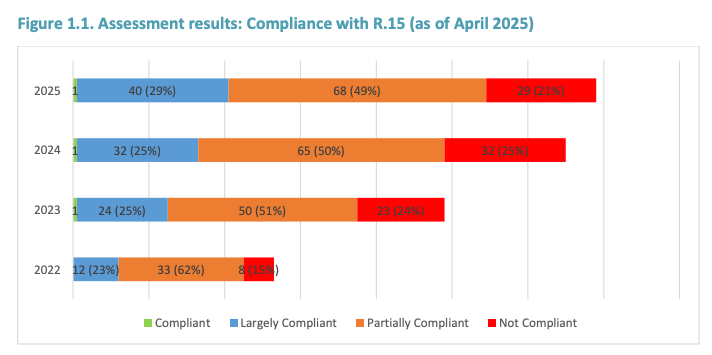
Source: FATF
The FATF assessment found that 49% of jurisdictions were only partially compliant with requirements for CASPs, while 21% remained non-compliant as of April 2025, leaving only about 29% of jurisdictions rated largely compliant or compliant.
Magazine: China’s 107 Bitcoin memory thief, Bithumb CEO booked: Asia Express