
As blockchain technology gains popularity, securing blockchain applications is becoming increasingly important. With rapid advancements, it’s essential for developers to understand how to protect blockchain networks and secure smart contracts. Vulnerabilities can lead to significant financial losses and damage to reputations, but don’t worry—we’re here to help!
This article explores common blockchain vulnerabilities, cryptographic principles, smart contract security best practices, strategies to prevent 51% attacks, and how decentralization impacts overall security.
What You’ll Learn
Common Blockchain vulnerabilities and how they can be exploited.Cryptographic HashingSmart contract securityUnderstanding 51% of attacks and prevention strategiesDecentralization’s role in security
Let’s dive in!

Section 1: Blockchain Vulnerabilities
1.1 Blockchain vulnerabilities
Blockchain Vulnerabilities are the susceptibilities within the system that cyber attackers can exploit to breach the data integrity, disrupt services, or gain unauthorized access. Understanding these vulnerabilities is essential for strengthening the security of blockchain networks. Some of the most common types are:
1. Double-Spending Attacks: Double Spending attacks occur when the attacker spends the same digital currency more than once. This takes place when they take advantage of the time taken by the network to confirm the transaction. The attacker tricks the system into accepting two transactions using the same amount. This attack is a potential risk to the entire blockchain system and can result in huge financial losses.
Real-life example: In 2014, a cryptocurrency Feathercoin suffered loss and stealing of funds due to a Double spending attack. The attacker managed to send a transaction to an exchange and then manipulated the blockchain to invalidate the transaction.
2. Race Attacks: Race attacks are a certain kind of Double Spending attacks. In this attack, the attacker creates a race condition of two conflicting transactions simultaneously. Among the two transactions one is sent to the merchant and the other one is broadcasted to the network. The goal is to ensure the transaction that benefits the attacker gets confirmed while the other is invalidated.
Real-life Example: Bitcoin ATMs are vulnerable to race conditions and the attacker can make the instant purchase with zero-confirmation.
3. Finney Attacks: A Finney attack is a specific kind of Double spending attack, where the attacker uses their own mined block to execute a fraudulent transaction. This attack was named after Hal Finney, one of the early contributors to Bitcoin. It exploits the transaction time and process of occurrence.
4. Vector76 Attacks: Vector76 is a hybrid attack of both Race and Finney attacks. In this scenario, an attacker first mines a block that contains a double-spend transaction. They then release this block to the network only after they have completed a race attack, ensuring the double-spend is confirmed.
5. Transaction Malleability: This is a weakness that allows the attacker to alter the hash of the transaction without changing the other core details. By changing the transaction ID it allows the attackers to manipulate the flow of the transaction.
Real-Life Example: The Mt. Gox Bitcoin exchange collapse in 2014 was partially due to transaction malleability attacks, where hackers altered transaction IDs to make it seem like transfers had not occurred.
6. Sybil Attacks: Within the Sybil attack, the attacker creates several fake identities within the network, helping the malicious actor to have a highly disproportionate influence over the system. With the greater number of nodes held, the attacker then manipulates the voting or decision-making processes that disrupt the blockchain’s operations.
Code snippet of Sybil Attack:
7.DDoS (Distributed Denial of Service) Attacks: An example of a DDoS attack is an attempt at overwhelming the resources of a blockchain network with lots of requests, which is going to make it slow down or crash. It consumes system resources in such a manner that it impacts legitimate transactions, which are delayed or interrupted, and generally reduces the performance and availability of the blockchain.
Real-Life Example: In 2016, Ethereum experienced a DDoS attack that exploited vulnerabilities in the network’s transaction processing, causing massive delays and increasing the cost of transactions.
1.2 Vulnerabilities in Consensus Mechanisms
Consensus Mechanisms are the protocols that the participants agree on to validate the transaction. However, each consensus mechanism has its vulnerabilities that the attacker can exploit. Let’s have a look at the vulnerabilities associated with the various algorithms in detail:
1. Proof of Work (PoW): Proof of Work is a widely used consensus mechanism, primarily in cryptocurrencies like Bitcoin. PoW despite being robust has several vulnerabilities.
51% Attack: In this attack, if a single entity or an organization controls more than 50% of the network’s computational power then they can manipulate the blockchain. This could include double spending, blocking, and altering the additions of new blocks.High Energy Consumption: This is not an obvious attack but this is the vulnerability or flaw in the algorithm. In PoW, since the computational power required for mining is huge hence it makes it inefficient and environmentally unsustainable.Centralization Risk: Miners with huge resources can dominate the network, leading to mining centralization, which rules out the decentralized nature of the blockchain.
2. Proof of Stake (PoS): Even though PoS is an energy-efficient alternative to PoS, It still has some vulnerabilities of its own:
Nothing at Stake: Validators might validate multiple chains simultaneously and this can result in them having nothing to lose. This could lead to double spending.Wealth Concentration & Centralization: In PoS, validators with more coins to stake have higher chances of being selected and getting to validate the transactions. Hence, over time this can lead to wealth concentration where only the wealthy participants control the network undermining the centralization.Long-range attacks: Attackers can use old private keys and create an alternative chain from a long time ago and confuse the current state of the blockchain.
3. Delegated Proof of Stake (DPoS): DPos is the modified form of PoS with Delegated authorities.
Centralized Power: By having few delegates maintain the network, a system becomes more centralized and may raise the chances of collusion or manipulation among these delegates.Bribery Attacks: This method is also vulnerable to bribery or vote-buying, in which malicious actors offer incentives to voters in return for their votes. Consequently, the integrity of the consensus process is compromised.Low Voter Turnout: One of the major problems in systems of DPoS is voter apathy, whereby only small percentages of participants vote. This often means that the few selected delegates are re-elected time and again; thus, the power becomes concentrated among them.
Section 2: Cryptographic Hashing
Cryptographic hashing is crucial for securing blockchain data. A cryptographic hash creates a unique identifier for a block, acting as its digital fingerprint. Key properties of hash functions include:
2.1 Cryptographic Principles in Blockchain
Blockchain leverages several cryptographic techniques, including:
Properties of Hash Functions:
Deterministic: The same input yields the same output maintaining the consistency and deterministic nature.Fast computation: The hash calculation process should be quick and efficient, even for large datasets.Pre-image resistance: It should be computationally infeasible to reverse-engineer the original input from its hash.Avalanche effect: Small changes in input result in a drastic change in output
Popular Hashing Algorithms:
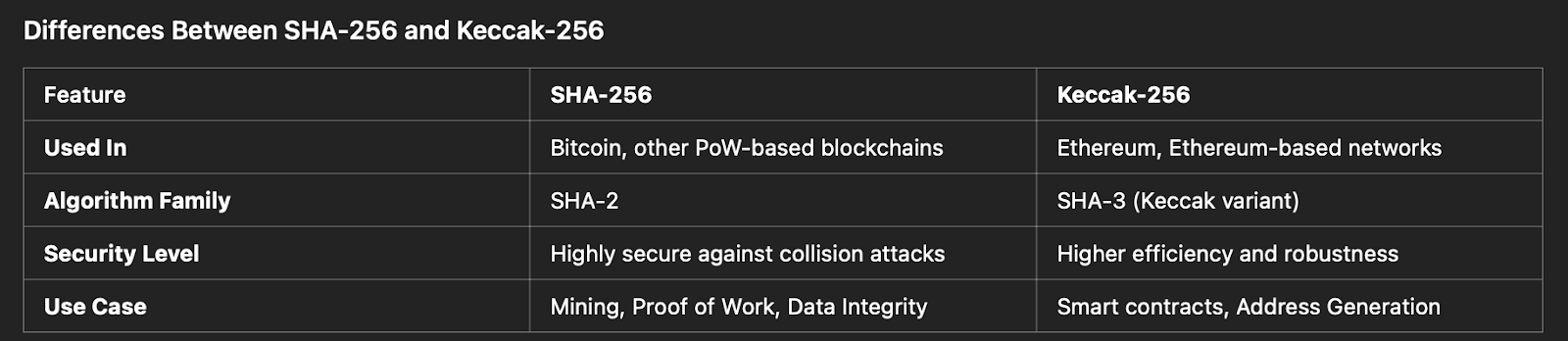
SHA-256: Secure Hashing Algorithm 256 is widely used and renowned for securing Bitcoin. This algorithm generates a unique, fixed-size 256-bit (64-character) hash value from any input data, ensuring that even the slightest change in the input produces a completely different output. This algorithm is used to create digital signatures that provide authentication and security for blockchain
print(f”SHA-256 Hash: {hash_value}”)
Keccak-256: Keccak -256 is the hash function used for Ethereum.It is used to secure transactions and interactions of smart contracts.
print(f”Keccak-256 Hash: {hash_value}”)
2.2 Cryptographic Techniques for Data Security
Public Key Infrastructure (PKI): PKI is a cryptography technique in which there is key pair generation: public and private keys for encryption and decryption respectively. Using private keys one can authenticate the origin and integrity of the transactions in the form of a digital signature.
# Generate private and public keysprivate_key = rsa.generate_private_key(public_exponent=65537, key_size=2048)public_key = private_key.public_key()
# Data to signmessage = b”Secure Blockchain Transaction”signature = private_key.sign( message, padding.PSS(mgf=padding.MGF1(hashes.SHA256()), salt_length=padding.PSS.MAX_LENGTH), hashes.SHA256())print(f”Digital Signature: {signature}”)
Digital Signatures: Digital Signatures authenticate and validate the transactions. One of the widely used ones is the Elliptic Curve Digital Signature Algorithm (ECDSA).Merkle Trees: Merkle Trees as the name suggests is a data structure that is used to efficiently verify the integrity of data blocks. They enable quick verification of data consistency and validity without the need to check every individual data point.
Section 3: Smart Contract Security
1. Reentrancy Attacks: In a Reentrancy attack, a function calls another contract before resolving its state first hence allowing the contract to re-enter the original function. This allows the external contract to re-enter the calling function and manipulate the state in unintended ways, potentially leading to unauthorized fund withdrawals.
Example code snippet:
contract VulnerableContract { mapping(address => uint256) public balances; function deposit() public payable { balances[msg.sender] += msg.value; } function withdraw(uint256 amount) public { require(balances[msg.sender] >= amount, “Insufficient balance”); // Vulnerable: External call before state update (bool success, ) = msg.sender.call{value: amount}(“”); require(success, “Transfer failed”); balances[msg.sender] -= amount; // State update after external call }}
In the above code example the contract sends Ether to msg.sender before updating their balance.Noe the attacker can exploit this vulnerability can exploit this by calling withdraw recursively draining the funds.
2. Integer Overflow and Underflow: Integer overflow and underflow as the name suggests is manipulating the operations to exceed or fall short the permissible data range that can lead to a faulty contract.
3. Gas Limit Vulnerabilities: Smart contracts that exceed the gas limit may fail to execute, leading to incomplete transactions. This can be exploited in denial-of-service (DoS) attacks, especially in loops over dynamic data structures without bounds.
3. Access Control Flaws: Lack of proper access controls results in unauthorized function calls.
4. Unhandled Exceptions and Fallback Functions: Poor handling of exceptions can lead to unexpected behaviors and loss of funds. Fallback functions without proper logic can inadvertently accept Ether or allow unintended interactions.
3.2 Best Practices for Secure Smart Contract Development
Using Established SafeMath Libraries like OpenZeppelin and other security libraries.
contract SecureContract { using SafeMath for uint256; uint256 public balance; function deposit(uint256 amount) public { balance = balance.add(amount); }}
Code Audits and Testing: Regularly review the code, use tools like MythX, and Remix IDE for scanning and resolving the issues.Upgradeability Patterns: Safeguard future changes and upgrades using proxy contracts and Diamond patterns. Implement the Checks-Effects-Interactions pattern to manage state updates before making external calls.Avoid Unbounded Loops and ensure the upper bounds to prevent exceeding the gas limits.Use access control modifiers and restrict the function access using role-based controls
Section 4: 51% Attacks and Prevention Strategies
4.1 Understanding 51% Attacks
51% attack, occurs when a single entity or a group of entities gains control of the majority of the network’s computational power, which enables them to manipulate the Blockchain network and ledger
Due to this intensity of control, the attacker can perform some dangerous attacks like Double Spending, and can also alter the order of transactions which can tamper with the blockchain history
4.2 Strategies to Prevent 51% Attacks
Decentralizing Hash Power: Motivate for a distributed mining power to reduce centralized attack risks.Chain Reorganization Limits: Set limits to block reorganization in the consensus protocol.Checkpointing Mechanisms: Use regular checkpoints to secure the blockchain state.
Case-Study: The Ethereum DAO Hack:
Ethereum suffered the biggest loss and the most significant attack in 2016 The attack targeted a decentralized autonomous organization (DAO) called “The DAO,” which was designed to be a venture capital fund with funds raised through the sale of tokens.
Vulnerability: The attack was based on Reentracy attack vulnerability. Reentrancy attack –when a function in a smart contract makes an external call to another contract before the state of the original contract is updated. This allowed the attacker to withdraw funds from the DAO repeatedly before the smart contract could update its balance.
The core issue example code snippet:
contract VulnerableContract { mapping(address => uint) public balances; // Function to deposit Ether into the contract function deposit() public payable { balances[msg.sender] += msg.value; } // Function to withdraw Ether from the contract function withdraw(uint _amount) public { require(balances[msg.sender] >= _amount, “Insufficient balance”);
// Vulnerable code: transferring Ether before updating state (bool success, ) = msg.sender.call{value: _amount}(“”); require(success, “Transfer failed”); balances[msg.sender] -= _amount; // State update after external call }}
This attack resulted in a 3.6 million Ether loss worth $50 million. This hack severely damaged the reputation of Ethereum and caused panic in the cryptocurrency community.
Section 5: Decentralization’s Role in Security
As we know, decentralization distributes control over the network among all the participant nodes. This makes the network more robust and resistant to attacks.
5.1 Importance of Decentralization in Blockchain
Decentralization plays a key role in Security due to the following factors:
Resilience Against AttacksDistributed ConsensusTrustless Environment
5.2 Challenges of Decentralization
Decentralization is primary to blockchain. However, it still comes with challenges that developers need to address. Here are the two main issues:
Scalability Issues: Decentralized Blockchains have a limited transaction processing speed(TPS), for instance, Bitcoin can handle 7TPS and Ethereum about 15-30 TPS which is significantly less than the centralized systems. For instance, Visa can handle thousands of TPS. Hence, scaling the transaction throughput is a big challenge. After this improving the latency and Propagation time still stands as a challenge in the way of Decentralized systems.Network Partitioning Attacks: In a network partitioning attack, attackers aim to isolate a specific set of nodes from the rest of the blockchain network. By cutting off communication with other nodes, attackers can create a separate ledger history that differs from the main blockchain.
6.1 Practical Exercises: Developers’ Battleground
Simulate a 51% Attack: Create a controlled environment using testnets like Ropsten or Rinkeby to demonstrate how a 51% attack might be executed.
Steps
Setup a Private Ethereum NetworkConfigure Multiple NodesControl the Majority Hash PowerPerform TransactionsExecute the attackAnalyze the results
Tools:
Geth: Ethereum client for running nodesRopsten or Rinkeby Testnets: These are test environments
Smart Contract Security Testing: Use tools like MythX or Remix IDE to identify vulnerabilities in smart contracts.
Steps:
Deploy the Contract in Remix IDEAnalyze with static analysis toolsIdentify VulnerabilitiesFix the IssueRe-analyzeWrite the Unit Test
Tools
Example code snippet:
contract VulnerableContract { mapping(address => uint) public balances;
// Function to deposit ether into the contract function deposit() public payable { balances[msg.sender] += msg.value; } // Function to withdraw ether from the contract function withdraw(uint _amount) public { require(balances[msg.sender] >= _amount, “Insufficient balance”);
// Vulnerable code: transferring ether before updating state (bool success, ) = msg.sender.call{value: _amount}(“”); require(success, “Transfer failed”); balances[msg.sender] -= _amount; // State update after external call
}
}
Conclusion
Blockchain security is a domain that needs keen vigilance and continuous adaptation to new threats. By understanding the cryptographic techniques and hashing, securing the smart contracts and mitigating the smart contract vulnerabilities becomes easier. Hence, stay curious and keep learning to stay ahead of the evolving landscape. Happy coding and Secure Building!!
We’d Love to Hear Your Thoughts on This Article!
Was this writing helpful?
Disclaimer and Risk Warning
The information provided in this content by Coinpedia Academy is for general knowledge and educational purpose only. It is not financial, professional or legal advice, and does not endorse any specific product or service. The organization is not responsible for any losses you may experience. And, Creators own the copyright for images and videos used. If you find any of the contents published inappropriate, please feel free to inform us.