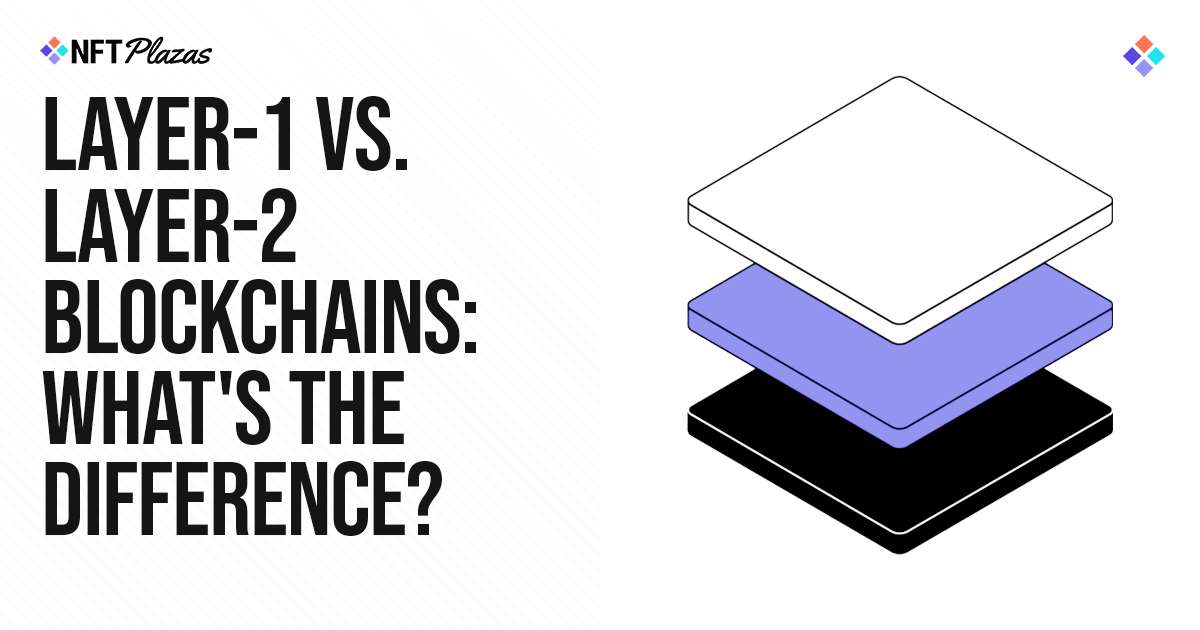
If you’ve been in the blockchain space for some time, you’ve probably seen the terms Layer-1 and Layer-2 used to refer to blockchains – but what do these mean? What are the differences?
These terms describe fundamental differences to the structure of a blockchain, and grasping them is crucial to developing an understanding of blockchain scalability, security, and efficiency.
Looking for the short answer? In essence:
Layer-1 blockchains are big, major, foundational networks, such as Bitcoin, Ethereum and Solana. They are the tree trunk, from which everything else branches from. They are trusted and secure, but often also cumbersome as they’re designed to be a general tool, rather than optimised for a specific task. This means transaction speed is low, and costs are high.Layer-2 blockchains are side networks, built on top of Layer-1 blockchains, such as Polygon, Immutable, and Base. They are the branches, sprouting from the tree trunk. They are often specialised for a specific niche, e.g. blockchain games, and process high-volume transactions away from the main blockchain, allowing apps to run at speed without clogging the Layer-1 network. This means transaction speeds are high, costs are low – and as security is garnered from the Layer-1 it is branching from, security is still strong.Layer-3 blockchains are specialist networks, built on top of Layer-2 blockchains. They are the leaves, sprouting from the branches. These are often reserved for particular high-volume apps, to prevent transactions from clogging the Layer-2 network. As they’re built specifically for one app, this means transaction speeds are very high, and costs are very low.

Want to dive deeper and learn how it all works? Read on…

What is a Layer-1 blockchain?
Layer-1 blockchains are the backbone of a decentralized world. They are responsible for processing and finalizing transactions at the pinnacle of security and integrity.. Some of the most well-known Layer-1 blockchains include Bitcoin (BTC), Ethereum (ETH), and Solana (SOL).
Bitcoin was the first Layer-1 blockchain. Designed for peer-to-peer transactions, and using a proof-of-work consensus mechanism, it trades speed and volume for outright security – meaning that whilst it’s ideal for securely handling a small volume of important transactions, it struggles to scale effectively.
Ethereum expanded on Bitcoin by introducing smart contracts, enabling the development of decentralized applications (dApps). However, the rise of the first high-volume blockchain-based game, CryptoKitties, congested Ethereum to such an extent that most of Ethereum’s traffic was dedicated solely to supporting the CryptoKitties game, sending transaction speed through the floor, and transaction prices through the roof.
This spurned the development of some of the first Ethereum Layer-2 blockchains (such as Polygon and Immutable), and new Layer-1 blockchains that aimed to solve the same problem, such as Flow.
Many other Layer-1 blockchains have since sprung up, each attempting to be a solid backbone for further development.
Layer-1’s process transactions by verifying their authenticity through a network of nodes (individual sets of computer hardware), and recording them in blocks. Once a block of transactions is verified, it is added to the blockchain, making the transactions irreversible and secure.
Most Layer-1 blockchains are siloed, meaning they cannot communicate with other Layer-1 networks, though there is growing interest in building bridges – tools which can allow Layer-1 blockchains to communicate amongst each other, allowing assets to be send between them.

What is a Layer-2 blockchain?
Layer-2 blockchains are built on top of Layer-1 blockchains to expand their scalability or expand their functionality. They often specialise in a particular niche, and aim to offload some of the transactional burden from the Layer-1, allowing for faster and cheaper transactions for high-volume apps.
Polygon is one of the most well-known Layer-2 solutions for Ethereum. It uses an array of sidechains to process transactions, which are then batched and finalised onto Ethereum – meaning that instead of paying for one expensive Ethereum transaction, you’re paying for a small fraction of one transaction that is combined with many others, making speeds much higher and fees much lower.
Immutable – a gaming-focused Layer-2 – furthered Layer-2 technology by introducing zero-knowledge (ZK) rollups, which – in short – allow huge numbers of transactions to be verified and processed without any drawbacks on security, providing a new level of scalability to blockchains.
Unlike Layer-1 blockchains, as they are branched from their parent chain, many Layer-2 networks can communicate with one another, allowing a wide variety of apps to share data and work with one another.

What is a Layer-3 blockchain?
Layer-3 blockchains used to be stunningly rare, but are becoming increasingly common as apps chase peak optimization.
Layer-3 blockchains are built on top of Layer-2 blockchains, and are often built to support one particular app or game. This allows that app or game to benefit from even faster transactions and even lower costs.
This is typically done either in anticipation of an app’s huge popularity, or if a Layer-2 app is pushing such a high-volume of transactions that it is clogging the Layer-2 and affecting other apps on the network.
We’ve written about two Layer-3 blockchains recently: Anomaly, a Ethereum Layer-3 AI gaming platform; and Arbitrum Orbit, an Ethereum Layer-3 that was the former home for popular web3 MMORPG LumiTerra.
Now that you understand the differences between a Layer-1, Layer-2 and Layer-3 blockchain, it will be easier to both understand and navigate the increasingly complex world of blockchain technology. Remember: Layer-1s are the trunks, Layer-2s are the branches, and Layer-3s are the leaves!