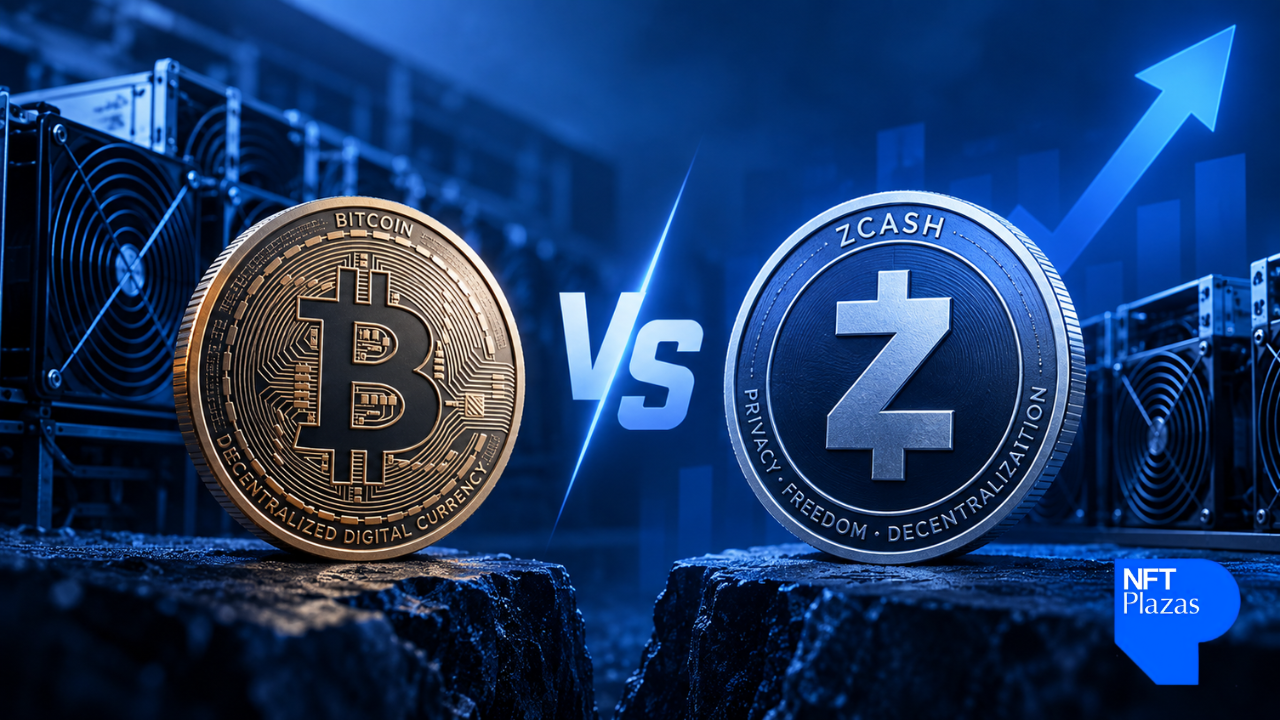
Zcash mining has become significantly more profitable than Bitcoin mining for individual operators, according to a new analysis from Grayscale Research, even as Bitcoin continues to dominate the mining industry in overall scale.
The report, led by Grayscale Research director Zach Pandl, highlights a sharp difference between the two proof-of-work networks. Bitcoin generates far more money for miners collectively, but Zcash currently offers substantially higher returns per machine and per unit of electricity consumed.
The shift comes as Zcash (ZEC) has staged one of its strongest rallies in years, pushing its price above $1,000 and attracting more computing power to the network.
Bitcoin dominates the reward pool
Bitcoin remains in a different league when measured by the total value distributed to miners.

Grayscale estimates that Bitcoin miners collectively generate around $35 million in daily rewards, compared with roughly $2 million for Zcash miners. The difference reflects Bitcoin’s much larger market capitalization, network activity and mining infrastructure.
But the comparison changes when looking at individual machines.
According to Grayscale, a typical Zcash mining rig currently generates about twice the daily revenue of a comparable Bitcoin mining machine. The advantage becomes even more pronounced when electricity consumption is considered.
Zcash mining produces approximately four times as much revenue per megawatt-hour as Bitcoin mining under Grayscale’s assumptions. The research firm said Zcash mining can currently generate higher revenue per unit of electricity than some artificial intelligence and high-performance computing cloud services.
That does not mean Zcash mining is four times more profitable in every market. Electricity prices, hardware costs, cooling, maintenance, pool fees and network difficulty can significantly change the economics for individual operators.

Zcash mining activity is up ~2.5x this year (Source: Grayscale)
ZEC’s price rally changes the equation
The improvement in Zcash mining economics has largely followed the cryptocurrency’s dramatic price appreciation.
ZEC recently climbed to around $1,155, its highest level in roughly nine years, extending a powerful rally that has made it one of the strongest-performing large-cap cryptocurrencies.
The token was up more than 14% over the week at one point, while Bitcoin declined by nearly 3% over the same period. ZEC’s market capitalization reached approximately $19.5 billion.
The rally has also pushed Zcash well beyond its levels earlier in 2026. Grayscale said ZEC’s price gains have encouraged miners to deploy more computing power, with the network’s total mining activity increasing more than 2.5 times since the beginning of the year.
That creates an important feedback loop for the network. Higher ZEC prices make mining more attractive, which encourages additional miners to participate. More mining power increases competition but also strengthens the security of the blockchain.
Pandl described the relationship as potentially reinforcing, with stronger mining economics supporting greater network security and potentially helping sustain investor interest.

Zcash (ZEC) 1Y Price Performance (Source: CoinGecko)
The machines cannot simply switch networks
There is an important limitation to any direct comparison between Bitcoin and Zcash mining.
The two networks use different mining algorithms and specialized hardware. Bitcoin relies on SHA-256 ASICs, while Zcash uses the Equihash algorithm. As a result, a Bitcoin miner cannot simply redirect a Bitcoin ASIC to Zcash when ZEC becomes more profitable.
Grayscale’s analysis compares a Bitmain S23 Hydro Bitcoin miner with a Bitmain Z15 Pro Zcash miner. Its calculations assume electricity costs of $0.05 per kilowatt-hour, full uptime and no transaction-fee revenue.
The estimates also focus on mining revenue rather than an operator’s final net profit. Hardware depreciation or financing, facility costs, cooling, maintenance and pool fees can materially reduce actual returns.
Electricity is particularly important. A miner operating in a region with expensive power may find that the apparent advantage disappears once operating expenses are included.
Zcash’s smaller reward pool creates a catch
The biggest question for prospective Zcash miners is whether the current advantage can last.
Zcash’s daily mining rewards are only a fraction of Bitcoin’s. With approximately $2 million distributed across its mining network each day, the pool of available rewards is relatively small.
As more miners enter the market, the same reward pool must be divided among more computing power. Rising hashrate and network difficulty can therefore reduce the amount earned by each machine, even if the price of ZEC remains unchanged.
This dynamic is already visible in Zcash’s rapidly expanding hashrate. The more than 2.5-fold increase in mining activity this year demonstrates how quickly miners can respond when economics improve.
Bitcoin faces the same basic mechanism, although its much larger mining ecosystem and reward pool operate on a vastly different scale.

ZEC hashrate (Source: 2miners.com)
Institutional demand adds another layer
The mining boom is unfolding alongside growing institutional interest in Zcash.
Grayscale’s own Zcash investment product, ZCSH, began trading on NYSE Arca on August 25. The asset manager said the fund attracted about $179 million in net assets during its first 11 trading days, taking assets under management above $700 million.
Grayscale said ZCSH ranked among the top 1% of nearly 4,000 exchange-traded products by net asset growth and described it as the fastest-growing altcoin exchange-traded product by net assets. Those figures are based on the issuer’s own data.
The combination of rising institutional demand, stronger prices and improving mining economics has therefore created a much more favorable environment for Zcash than it had earlier in the year.
Efficiency, not size, is the key takeaway
Grayscale’s research does not suggest that Zcash has overtaken Bitcoin as a mining business overall. Bitcoin remains overwhelmingly larger in total mining revenue and infrastructure.
Instead, the analysis highlights a different metric: how much revenue an individual mining machine can generate relative to the electricity it consumes.
On that measure, Zcash currently has a clear advantage.
Whether that advantage persists will depend on ZEC’s price, electricity costs, mining difficulty and the amount of new hardware entering the network. The rapid growth in Zcash hashrate suggests miners are already responding to the opportunity.
For now, however, Grayscale’s conclusion is straightforward: Bitcoin remains the bigger mining network, but Zcash is offering considerably better mining economics for individual machines and electricity consumption.