
Bitcoin enters April with a price carrying the weight of macro conditions, corporate balance sheets, and the credibility of the public wrappers built around it.
CryptoSlate has already laid out the broad structure: public equities created a new channel for balance-sheet demand, the premium on that demand opened the door to further issuance, and the cycle began feeding itself.
Later coverage on slowing purchase volumes and the economics of being underwater on treasury holdings narrowed the focus to which companies could keep financing the trade once price and sentiment turned less forgiving.
New disclosures around the Bitcoin treasury company, Nakamoto, sharpen that focus.

Bitcoin treasury company sells Bitcoin at a loss
Bitcoin is currently trading around $66,200 on March 31, while NAKA changed hands near $0.21, leaving the company with an equity market capitalization close to $8.1 million. Back in May 2025, the stock hit an all-time high of $34.77, then declined to around $8 by the start of September and to $0.93 by the end of October.
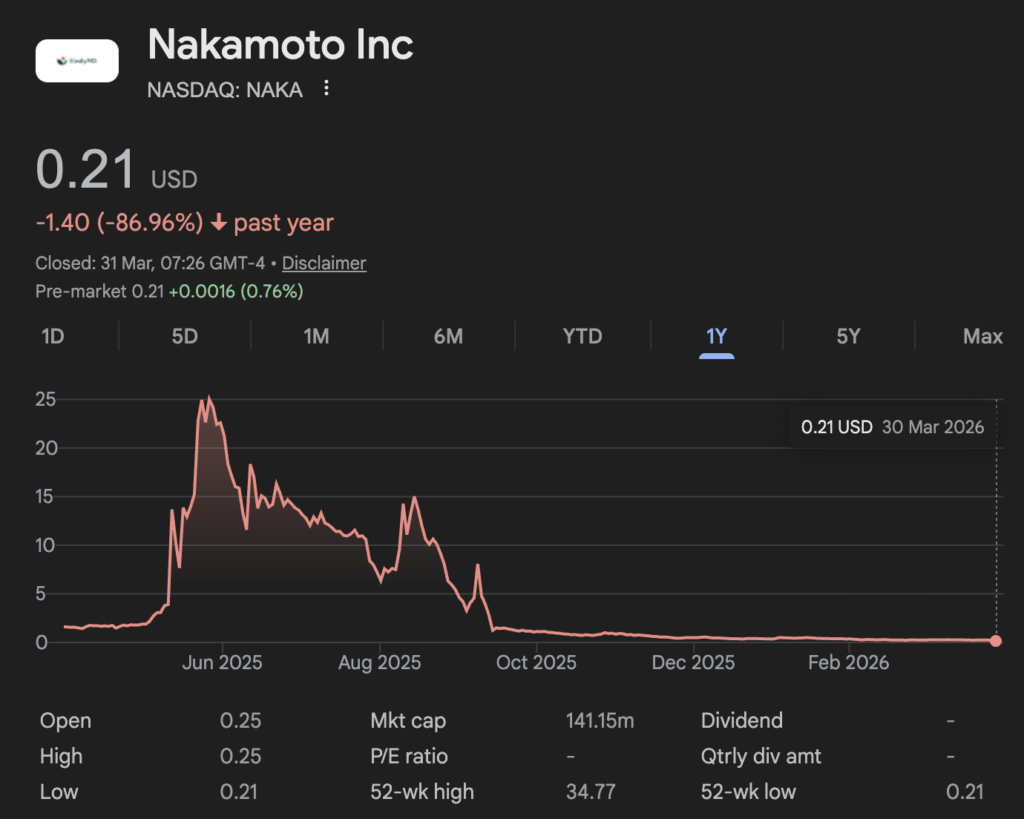
The spread between the underlying asset and the wrapper around it now defines the discussion.
The coin still trades as a globally recognized liquidity instrument. The stock trades like a distressed claim on a strategy whose financing assumptions no longer command the same confidence.
That gap grew more consequential after figures from Nakamoto’s March 30 annual filing circulated across crypto markets.
In a post from Wu Blockchain, later amplified by Justin Bechler, the company disclosed that it sold approximately 284 BTC in March for about $20 million, at an average sale price of $70,422 per coin, after net purchasing 5,342 BTC in 2025 at a weighted average price of $118,171.
Thus, a company that promoted Bitcoin treasury accumulation realized a sale at a price deep below the weighted average price from its prior buying campaign.
That change resets the economic lens. Unrealized losses fit inside the treasury-company model. They sit on the balance sheet, pressure equity valuations, and challenge access to capital, yet they still leave the company positioned for recovery if Bitcoin stabilizes and funding windows reopen.
Realized selling changes the sequence. It reduces the treasury, crystallizes the gap between acquisition cost and exit value, and invites a harder assessment of how management intends to fund operations, defend the stock, and preserve any premium the wrapper once carried.
NAKA stands as the clearest stress case because the company has also spent recent months expanding its corporate footprint.
In February, Nakamoto completed its acquisition of BTC Inc. and UTXO Management, issuing roughly 364.8 million shares in an all-stock transaction valued at around $81.6 million based on a February 19 closing price of $0.248.
That deal gave the company a larger role inside Bitcoin media, events, and advisory infrastructure.
It also tied the public wrapper more closely to the institutional Bitcoin narrative at precisely the point when the equity itself had already lost most of the market value investors once assigned to that narrative.
Bechler’s separate March 30 post on X pushed that credibility question further, pointing to insider ownership, the absence of open-market insider buying, the lack of recent treasury growth, and the stock’s collapse from prior levels.
Social posts do not settle filing-level questions like “Is this a managed treasury adjustment, or the first visible sign of funding stress?”, but they do shape how the market processes the capital structure.
In this case, the reaction is straightforward. Bitcoin remains the core asset.
The public vehicle around it has entered a phase where every treasury move, every financing choice, and every disclosure is being tested against survivability rather than ambition.
Macro pressure defines the week ahead, and Bitcoin treasury companies have to finance through it
The timing here raises the stakes because the first week of April puts Bitcoin back inside a dense macro calendar.
The March employment report from the Bureau of Labor Statistics arrives on Friday, April 3. U.S. equity markets are closed that day for Good Friday.
The combination produces a strange mix, one of the month’s most important macro releases landing into a holiday-shortened market structure with thinner price discovery across related assets.
Treasury wrappers tied to Bitcoin enter that window from a position of already elevated fragility.
Beyond payrolls, the market also has the Federal Reserve’s minutes from the March 17 to 18 FOMC meeting due on April 8.
That release will shape the rates discussion around growth, labor, inflation persistence, and the threshold for any policy adjustment later in the quarter.
For Bitcoin itself, those discussions often feed through the familiar channels, dollar liquidity, real yields, broad risk appetite, and institutional portfolio construction.
For treasury companies, the channel is even tighter because the effect shows up directly in financing costs, dilution sensitivity, and equity market willingness to keep underwriting balance-sheet accumulation.
Energy adds another layer.
Euro-area inflation rose to 2.5% in March from 1.9% in February, with energy costs driving the acceleration as the conflict involving Iran disrupted flows through the Gulf. Brent crude also reached roughly $106 a barrel during the escalation.
Bitcoin rarely trades in isolation during those episodes.
The asset gets pulled into a broader repricing of inflation expectations, growth concerns, and cross-asset liquidity.
Treasury companies tied to Bitcoin then absorb a second layer of pressure because the same macro shift raises the hurdle for equity issuance and compresses the market’s willingness to pay a premium over net asset value.
That is the economic climate for the week ahead, and the issue sits in the overlap between inflation risk and funding discipline.
A treasury company can carry a large Bitcoin reserve through volatility if it holds enough cash, commands enough investor trust, or retains access to external capital on acceptable terms.
Once those buffers weaken, each macro shock forces a narrower set of choices.
The equity can dilute at lower prices.
The balance sheet can tighten spending.
Treasury assets can be sold.
Management can seek a new corporate action to reset optics and compliance.
Under those conditions, Bitcoin itself remains the center of gravity because every treasury wrapper ultimately resolves back to the coin.
The corporate layer still affects market structure, especially when public companies aggregate demand at scale.
The weekly question now runs in the opposite direction.
Instead of asking how much Bitcoin public companies can absorb, the market is starting to ask how much stress those companies can absorb before their treasury becomes a source of supply.
That threshold carries wider consequences because it changes the direction of the flow.
Accumulation supports the institutional Bitcoin narrative.
Realized sales at steep losses introduce a new variable, forced or strategic distribution from the very vehicles built to represent long-duration conviction.
Nakamoto sharpens the next test for Bitcoin as the wrapper trades on durability, liquidity, and trust
Nakamoto’s position does not cover the entire sector, but a company built around a Bitcoin treasury strategy, which later expanded through the acquisition of Bitcoin-native operating businesses, has now been associated with a disclosed BTC sale far below its prior weighted average purchase price, while the equity trades near twenty-one cents.
That combination creates a sharper view of where the treasury model stands after the first wave of enthusiasm.
The premium era rewarded ambition, scale, and proximity to Bitcoin.
The current phase rewards durability, financing discipline, and the ability to preserve treasury optionality during stress.
That is why Bitcoin remains the correct focal point. The coin still provides the reference value for the whole trade.
A balance-sheet strategy only works if the market believes the treasury can be maintained, financed, and eventually leveraged into a stronger capital-markets position.
The moment the wrapper begins shrinking its Bitcoin stack into weakness, investors start valuing the company through a different lens.
Future upside from Bitcoin still exists.
The route to that upside becomes more conditional. Execution, liquidity, and trust move closer to the center of valuation.
Recent CryptoSlate coverage already prepared the groundwork for that transition. Public companies doubled Bitcoin holdings in 2024, and later reporting showed how aggressive corporate accumulation changed the supply picture.
The 2025 phase still carried that momentum. Then the data on slumping purchase volumes suggested a slower marginal buyer.
The latest Nakamoto disclosures bring another layer, weaker wrappers may now be moving from a world of paper losses into a world of realized sales.
That distinction has operational meaning for every investor trying to map where treasury-company demand sits in the current cycle.
None of this requires dramatic language. The capital structure already says enough.
A stock at $0.21 with a market cap around $8.1 million and a public identity tied to Bitcoin treasury expansion enters a much harder conversation once treasury reduction appears in the annual filing.
Social commentary has already drifted toward delisting speculation, reverse-split expectations, and questions around insider alignment.
The market is repricing the quality of the wrapper, and repricing it fast. The next test now sits in plain view.
If Bitcoin steadies, stronger treasury companies with cleaner balance sheets and broader financing access may keep their premium and continue absorbing supply.
If macro pressure persists and funding windows stay narrow, the market could begin separating the cohort into two groups, vehicles that can hold through the cycle, and vehicles that have to manage through it by selling coin, issuing equity from a position of weakness, or restructuring the capital stack.
Nakamoto has pushed that distinction closer to the surface.
Bitcoin remains the focal asset.
The public company ecosystem built around Bitcoin has entered a phase where conviction has to be funded, not simply declared.