
Invest In Crypto News
  • Home
  • Latest News
    • Bitcoin News
    • Altcoin News
    • Ethereum News
    • Blockchain News
    • Doge News
    • NFT News
    • Video
    • Market Analysis
    • Business
    • Finance
    • Politics
    • Mining
    • Regulation
    • Technology
  • Top 10 Cryptos
  • Market Cap List
  • IC DAO
  • Donations
  • Contact
  • Buy Crypto
  • BLOG
No Result
View All Result
Invest In Crypto News
No Result
View All Result

Bitcoin mining difficulty hits 148 trillion as revenues fall to three-month lows

CryptoExpert by CryptoExpert
October 30, 2026
in Ethereum News
0
Bitcoin is chained to a heavy rising block beside mining rigs and power pylons, symbolizing tighter margins after a difficulty increase.
  • Facebook
  • Twitter
  • Pinterest


You might also like

Stellar Launches Cross-Chain Messaging With Ethereum Through VIA Labs

US Treasury Plans New Crypto Rules After CLARITY Act Setback

Coinbase sets 3-day MiCA deadline for USDT, PayPal and Trump-linked stablecoins

Bitcoin’s mining difficulty jumped 5.54% on Oct. 29 as recovering network computing power intensified competition among miners already facing shrinking revenues.

Data from Nodewitness shows the adjustment increased difficulty from 140.58 trillion to 148.36 trillion, following another 5.92% increase on Oct. 16.

The increase comes as Bitcoin miners rebuild the network’s computing power despite an industrywide shift toward artificial intelligence infrastructure. However, the recovery is adding financial pressure, with mining revenue falling toward $33 per petahash per second daily, its lowest level since August.

Bitcoin miners rebuild network strength despite AI infrastructure shift

According to Real Vision chief crypto analyst Jamie Coutts, Bitcoin’s mining network has staged a substantial recovery following one of its steepest contractions in years.

Phemex

Coutts noted that the network’s 14-day average hashrate declined 23% between its October 2025 peak and February 2026, marking the steepest decline since China’s mining ban in 2021.

The contraction reflected several factors, including severe winter weather that temporarily disrupted operations and growing concerns that mining companies were abandoning Bitcoin production for more lucrative AI infrastructure opportunities.

Although the network initially recovered, its computing power weakened again through July, reinforcing concerns about the industry’s long-term commitment to Bitcoin mining.

However, Coutts said that trend has reversed significantly since July 17.

According to his analysis, Bitcoin’s hashrate has climbed 21% over the subsequent 102 days, adding approximately 185 exahashes per second (EH/s) and recovering to within 6% of its previous record.

He described the increase as the largest absolute amount of computing power added during a comparable hashrate recovery since 2018, although the percentage gain was less exceptional historically.

Data from Look Into Bitcoin also shows the network’s computing power has reached its highest level in seven months, illustrating the scale of the recovery despite the industry’s growing interest in AI infrastructure.
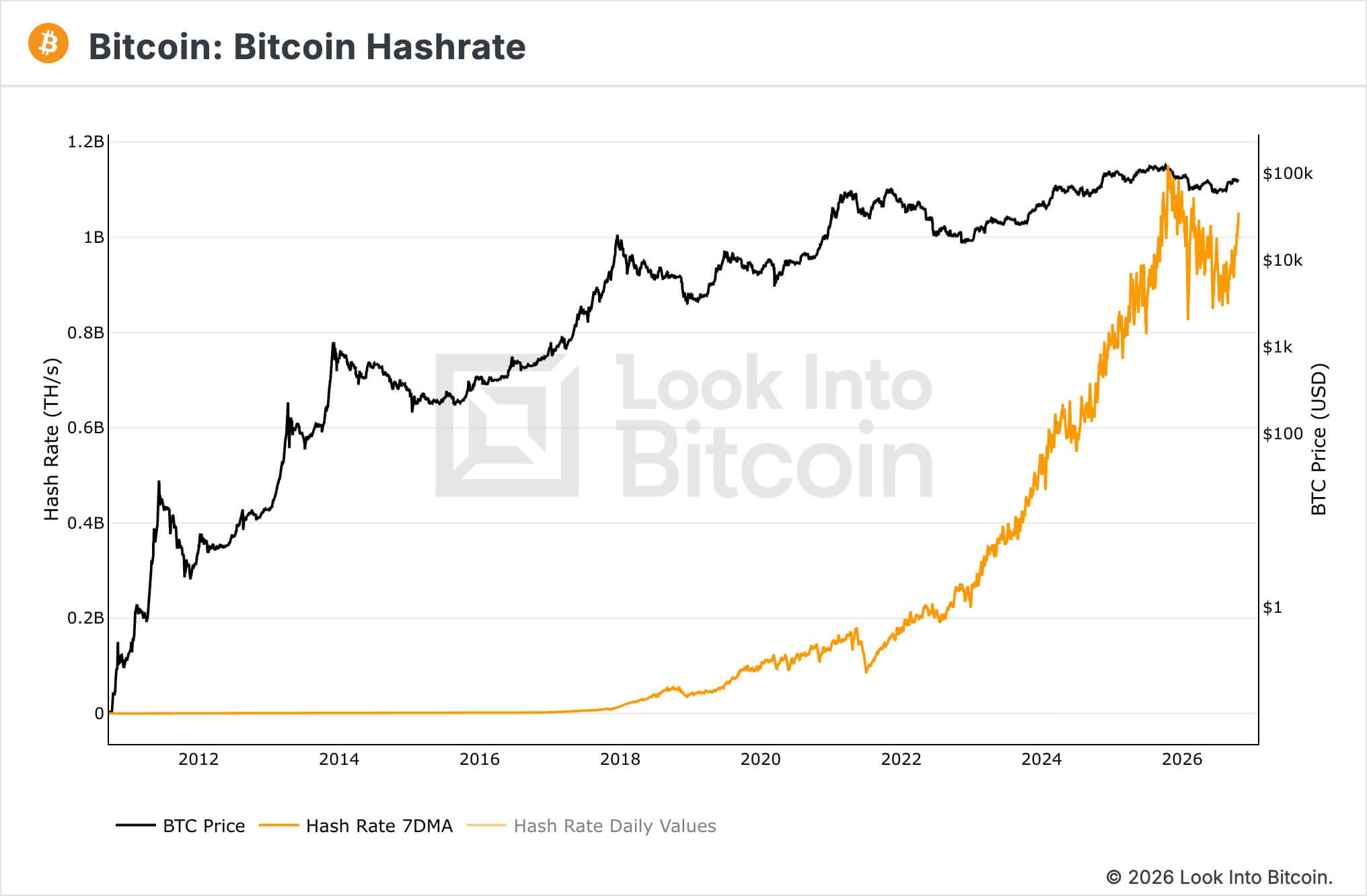
bitcoin hashrate
Chart Showing Bitcoin Network’s Hashrate (Source: Look Into Bitcoin)

The rebound is noteworthy because several publicly traded mining companies have increasingly shifted their business models toward high-performance computing and AI data centers, where long-term infrastructure contracts can provide more predictable revenue than Bitcoin mining.

Still, Bitcoin’s network-wide recovery suggests that mining capacity is expanding elsewhere, potentially offsetting equipment being redirected or retired by companies pursuing AI opportunities.

The return of computing power also helps explain the latest difficulty increases.

Bitcoin automatically adjusts mining difficulty every 2,016 blocks, roughly two weeks, to maintain an average block production time of 10 minutes. When additional computing power causes miners to find blocks faster than expected, the network raises difficulty to restore that target.

The Catalyst

Daily Newsletter

Know what’s moving crypto.

Start with the stories that matter. Get the context behind the headlines and a clear view of what to watch next.

Related Reading

Bitcoin’s next difficulty rise could leave some rigs earning less than their power bill

For Coutts, the recovery signals strengthening network security and continued confidence among operators willing to deploy computing resources despite difficult market conditions.

He noted that additional computing power raises the cost of attacking the Bitcoin network, while miners’ willingness to expand on thin margins suggests continued investment in its long-term prospects.

However, that growing competition carries a financial cost for the same companies securing the network.

Bitcoin mining revenue falls toward August lows

Bitcoin’s rising difficulty means individual miners must expend more computational work to earn the same expected amount of BTC, putting additional pressure on operators already struggling with electricity and infrastructure expenses.

The latest 5.54% adjustment alone reduces expected Bitcoin earnings per unit of unchanged computing power by approximately 5.24%, assuming transaction fees and other conditions remain constant.

Across the two October adjustments, the reduction reaches approximately 10.5%.

That pressure is reflected in Bitcoin’s hashprice, which measures expected daily mining revenue for each petahash per second of computing power.

Data from Startmining shows the metric has dropped to approximately $33 per PH/s per day, its weakest level since August. For comparison, Bitcoin’s hashprice averaged $40 in September, when the network’s difficulty was considerably lower.

This means miners are earning substantially less revenue from the same computing capacity, even before accounting for electricity, maintenance, hosting and financing costs.

The impact is particularly severe for operators using older, less efficient mining equipment.

For example, at a gross hashprice of $33.35, equipment operating at 25 joules per terahash would generate approximately $32.68 daily per PH/s after an assumed 2% mining pool fee.
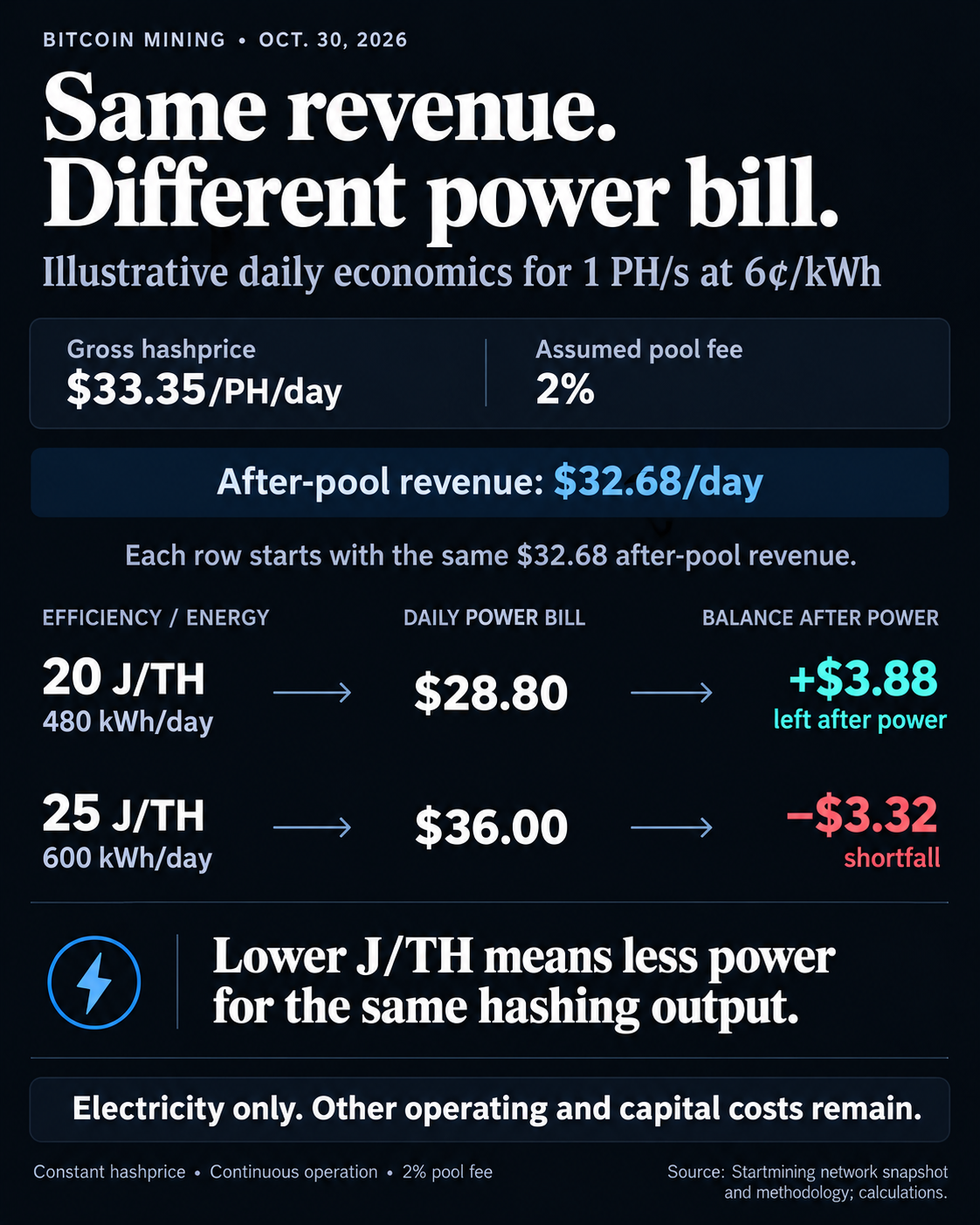
Illustrative daily mining economics per PH/s at 6 cents/kWh: $33.35 gross hashprice becomes $32.68 after an assumed 2% pool fee. A 20 J/TH machine spends $28.80 on power, leaving $3.88; a 25 J/TH machine spends $36, a $3.32 shortfall. Other costs remain.Illustrative daily mining economics per PH/s at 6 cents/kWh: $33.35 gross hashprice becomes $32.68 after an assumed 2% pool fee. A 20 J/TH machine spends $28.80 on power, leaving $3.88; a 25 J/TH machine spends $36, a $3.32 shortfall. Other costs remain.

At an electricity tariff of 6 cents per kilowatt-hour, however, the same equipment would incur a daily power bill of $36, producing a $3.32 shortfall before other operating expenses.

More efficient equipment rated at 20 J/TH would spend $28.80 on electricity under identical conditions, leaving a modest surplus before additional costs.

This illustrates how the network’s recovery is widening the financial divide between miners with access to cheap electricity and efficient machines and those operating older equipment at higher costs.

For miners operating at 25 J/TH, the current hashprice means electricity must cost approximately 5.45 cents per kilowatt-hour or less just to cover the power consumed by their machines.

The economics create a growing challenge for miners seeking to expand their computing capacity.

Additional mining equipment strengthens Bitcoin’s network, but it also raises competition for the available block rewards, putting further pressure on the revenue that supports those investments.




Source link

  • Facebook
  • Twitter
  • Pinterest
Tags: Bitcoin
CryptoExpert

CryptoExpert

Recommended For You

Stellar Launches Cross-Chain Messaging With Ethereum Through VIA Labs

by CryptoExpert
October 29, 2026
0
Stellar Launches Cross-Chain Messaging With Ethereum Through VIA Labs

TLDR VIA Labs launched two-way cross-chain messaging between Stellar’s Soroban platform and Ethereum mainnet. Developers can use it for stablecoin transfers, tokenized assets and cross-chain smart contract actions....

Read more

US Treasury Plans New Crypto Rules After CLARITY Act Setback

by CryptoExpert
October 28, 2026
0
US Treasury Plans New Crypto Rules After CLARITY Act Setback

Trusted Editorial content, reviewed by leading industry experts and seasoned editors. Ad Disclosure The US government isn’t waiting for Congress to settle the debate over cryptocurrency regulation. Speaking...

Read more

Coinbase sets 3-day MiCA deadline for USDT, PayPal and Trump-linked stablecoins

by CryptoExpert
October 27, 2026
0
Editorial collage showing a cracked USDT symbol beside USDC, Coinbase branding, and the European stablecoin conversion deadline.

Coinbase will automatically convert 14 restricted crypto tokens held by European customers on Oct. 30, including Tether's USDT.The exchange said in a customer notice that affected retail users...

Read more

AI Agents Rescue ETH’s Glamsterdam Fork, ‘Steal My Bitcoin’ Site: Hodler’s Digest

by CryptoExpert
October 26, 2026
0
Cointelegraph

AI agents message board set up to rescue Glamsterdam forkThe second and final testnet for Ethereum’s Glamsterdam hard fork was cancelled this week, after ChainSecurity found vulnerabilities in...

Read more

Ethereum Glamsterdam Upgrade Delayed as Contract Risks Emerge

by CryptoExpert
October 25, 2026
0
Ethereum Glamsterdam Upgrade Delayed as Contract Risks Emerge

TLDR Ethereum developers postponed the October 26 Glamsterdam activation on the Hoodi testnet. ChainSecurity identified 13 real-world cases of potential smart contract security risks. The postponement removes Hoodi’s...

Read more
Next Post
xrp ledger token rules

XRP Ledger Proposes 4 Fixes for Restricted Token Rules

Leave a Reply Cancel reply

Your email address will not be published. Required fields are marked *

Browse by Category

  • Altcoin News
  • Bitcoin News
  • Blockchain News
  • Business
  • Doge News
  • Ethereum News
  • Finance
  • Market Analysis
  • Mining
  • NFT News
  • Politics
  • Regulation
  • Technology
  • Trending Cryptos
  • Video

Sitemap

  • Market Cap
  • Donations
  • Trading
  • Mining
  • Contact

Legal Information

  • Privacy Policy
  • Anti-Spam Policy
  • Copyright Notice
  • DMCA Compliance
  • Social Media Disclaimer
  • Terms Of Service

Categories

  • Altcoin News
  • Bitcoin News
  • Blockchain News
  • Business
  • Doge News
  • Ethereum News
  • Finance
  • Market Analysis
  • Mining
  • NFT News
  • Politics
  • Regulation
  • Technology
  • Trending Cryptos
  • Video

© Copyright 2024 InvestInCryptoNews.com

No Result
View All Result
  • Home
  • Latest News
    • Bitcoin News
    • Altcoin News
    • Ethereum News
    • Blockchain News
    • Doge News
    • NFT News
    • Video
    • Market Analysis
    • Business
    • Finance
    • Politics
    • Mining
    • Regulation
    • Technology
  • Top 10 Cryptos
  • Market Cap List
  • IC DAO
  • Donations
  • Contact
  • Buy Crypto
  • BLOG

© Copyright 2024 InvestInCryptoNews.com

This website is using cookies to improve the user-friendliness. You agree by using the website further.

Privacy policy
bitcoin
Bitcoin (BTC) $ 76,898.00
ethereum
Ethereum (ETH) $ 2,239.64
tether
Tether (USDT) $ 0.999059
bnb
BNB (BNB) $ 700.45
xrp
XRP (XRP) $ 1.25
usd-coin
USDC (USDC) $ 0.999633
solana
Solana (SOL) $ 95.08
tron
TRON (TRX) $ 0.331167
staked-ether
Lido Staked Ether (STETH) $ 2,265.05
figure-heloc
Figure Heloc (FIGR_HELOC) $ 1.03

Pin It on Pinterest

Are you sure want to unlock this post?
Unlock left : 0
Are you sure want to cancel subscription?