
Bitcoin traded near $62,900 on Friday afternoon, down roughly 38% from its October 2025 all-time high, as Brent crude settled above $85 and the Strait of Hormuz remained effectively closed to normal commercial traffic.
By early Saturday, it had recovered to around $63,900, then traded flat throughout the EU morning.
The disputed waterway normally carries 20.9 million barrels of oil per day, about one-fifth of global petroleum consumption, but tanker crossings have collapsed to near-record lows after the United States reimposed a naval blockade on Iranian ports and Tehran responded with missile strikes on Gulf state infrastructure.
Oil futures, Treasury markets, and US equities will all close for the weekend, but Bitcoin won’t. That makes it the first liquid global asset forced to absorb whatever happens next in a conflict that the rest of the financial system can’t price until Monday.

Bitcoin’s Hormuz problem
Twenty million barrels per day is the normal flow through the Strait. Even partial disruption counts because oil markets price uncertainty before they price actual shortage. Tankers may delay departures rather than risk passage, so insurance and security costs can increase before physical supply is lost. Shipping restrictions can raise oil prices through fear alone.
Brent crude settled at $85.97 on July 17, up 2.06% from the previous day and 24% higher than a year earlier, according to Trading Economics. West Texas Intermediate rose to $80.93, up 2.51%.
The immediate trigger chain is pretty straightforward. The US launched roughly 140 strikes on Iranian military targets on July 11, the largest single strike package of the conflict to date, according to the Hormuz Strait Monitor. Iran retaliated with missile and drone attacks on US bases in Bahrain, Kuwait, Qatar, and Jordan, then struck two UAE-flagged supertankers in Omani territorial waters, killing one crew member.
Washington reimposed its naval blockade of Iranian ports on July 12, reversing a core provision of the earlier memorandum of understanding. The US says it will keep Hormuz open and has proposed recovering security costs through a charge on cargo. Iran says regular traffic depends on an end to US intervention.
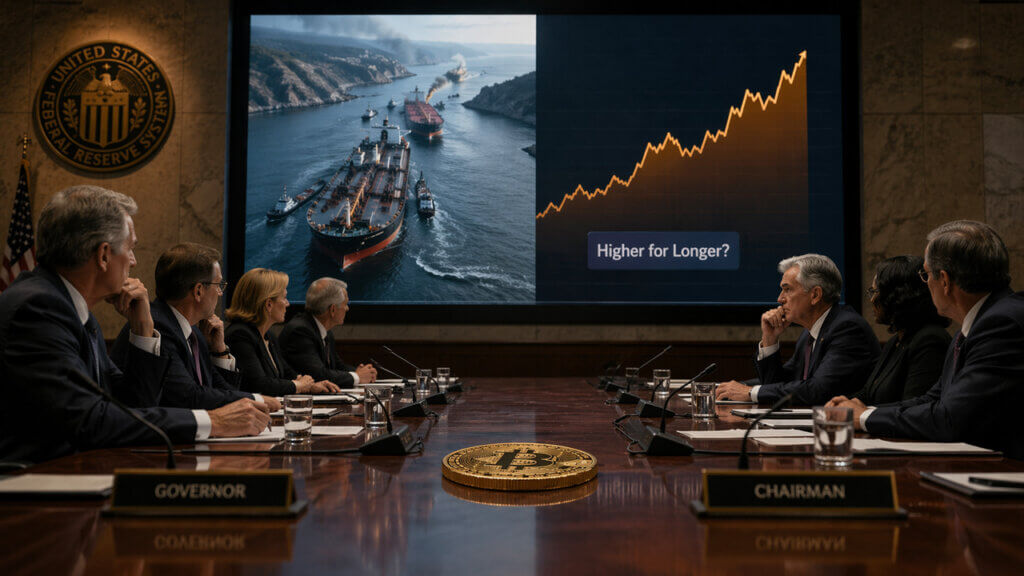
Higher crude and transport costs feed into inflation expectations. Renewed inflation expectations feed into anticipated Federal Reserve rates and Treasury yields. Higher anticipated yields then strengthen the demand for dollars, and a stronger dollar demand reduces appetite for leveraged and speculative assets.
All of that leads to Bitcoin. It isn’t that Bitcoin is directly tied to oil; it’s that it sits at the end of a risk-asset waterfall that starts with energy prices and flows through monetary policy.
The Federal Reserve has already tipped its hand. The committee held rates at 3.50% to 3.75% on June 17 in a unanimous 12-0 vote, but the updated dot plot showed a median year-end 2026 rate of 3.8%, up sharply from 3.4% in March. Nine of 18 officials penciled in at least one hike this year, and 17 of 18 judged inflation risks tilted to the upside. Headline CPI is running at 4.2%.
The next FOMC meeting is July 28-29, and as CryptoSlate previously covered, Fed officials are treating war-driven energy prices as an active inflation channel rather than a temporary shock. Kevin Warsh, who now chairs the Fed, has signaled that political pressure on monetary policy is a live variable, adding another layer of uncertainty to the July meeting.
The weekend problem: thin liquidity meets live news
When traditional markets close, Bitcoin becomes the only continuously traded global risk asset with enough liquidity to matter. That means any new tanker attack, shipping suspension, or military strike could hit Bitcoin hours before oil futures, Treasury markets, or US equities can respond. Traders who would normally hedge through those markets will have nowhere else to go.
Thin weekend order books magnify the danger. Fewer market makers are active on Saturdays and Sundays, which means that spreads widen and large market orders can move prices disproportionately. Liquidation cascades can accelerate quickly because there is less natural two-way flow to absorb them.
Perpetual futures funding rates, which reflect the cost of holding leveraged positions, can swing violently as directional bets pile up on one side. A trader attempting to hedge an anticipated Monday selloff in stocks might sell Bitcoin futures over the weekend, adding selling pressure to a market that already lacks buyers.
This is what makes weekends different from normal trading days. It isn’t that Bitcoin is a safe haven or a proxy for oil; it’s that it becomes a shadow market for risks that have nowhere else to go.
A sharp Bitcoin move following a verified military or shipping development would confirm that traders are using it as a temporary proxy for oil-supply risk, inflation expectations, Monday’s anticipated stock-market gap, and demand for dollars and cash. A Bitcoin move without a corresponding geopolitical catalyst should be treated cautiously; weekend volatility often reflects positioning rather than fundamentals.
The link between weekend Bitcoin price action and Monday traditional market opens isn’t reliable enough to trade blindly, but we’ve seen it play out too many times not to matter. CryptoSlate previously reported that Bitcoin’s 24/7 structure makes it one of the fastest ways for the market to express macro shifts, particularly when spot ETF demand is weak and leveraged traders are carrying more of the market’s momentum. With spot Bitcoin ETFs recording outflows in recent weeks, that leverage-dependent structure is still in place.
Several observable signals would escalate concern from a volatile weekend into something that reshapes Monday’s market open: a verified new tanker attack with casualties, a confirmed suspension of all Hormuz transit by a major shipping insurer, a US strike on Iranian nuclear facilities, or an Iranian missile reaching a populated area in a Gulf state capital.
Any of those would likely trigger a gap higher in Brent when futures reopen Sunday evening, a flight to the dollar, and selling pressure across risk assets that Bitcoin would absorb first.
But it’s important to note that de-escalation signals matter just as much. If shipping resumes through restricted corridors, or if a third-party mediator produces a temporary transit agreement, Bitcoin could rally as traders unwind weekend hedges. The point is that Bitcoin will price whatever happens first, and it will do so with less liquidity and more leverage than any traditional market.
Bitcoin traded near $62,746 on July 14, after an intraday low around $61,794. By Friday, it had recovered slightly to the $62,900 range, but the overall trend remains down roughly 38% from the October 2025 peak of $126,198. That decline has coincided with rising Treasury yields, a stronger dollar, and the same credit-market stress that CryptoSlate covered earlier this week. The Hormuz conflict adds a geopolitical accelerant to a macro backdrop that was already unfriendly to risk assets.
When oil futures reopen Sunday evening and Treasury futures begin trading in Asia, the market will test whether Bitcoin’s weekend move was prescient or noise.
If Bitcoin sold off sharply and Brent gaps higher, the crypto market will have served as an early warning system. If Bitcoin rallied and Brent opens flat, the weekend move will have been a liquidity artifact.
Either way, Bitcoin is the only market that gets to vote before the rest of the financial system returns on Monday. That’s a new role for an asset that was supposed to be digital gold, and it’s one that traders are still learning how to interpret.