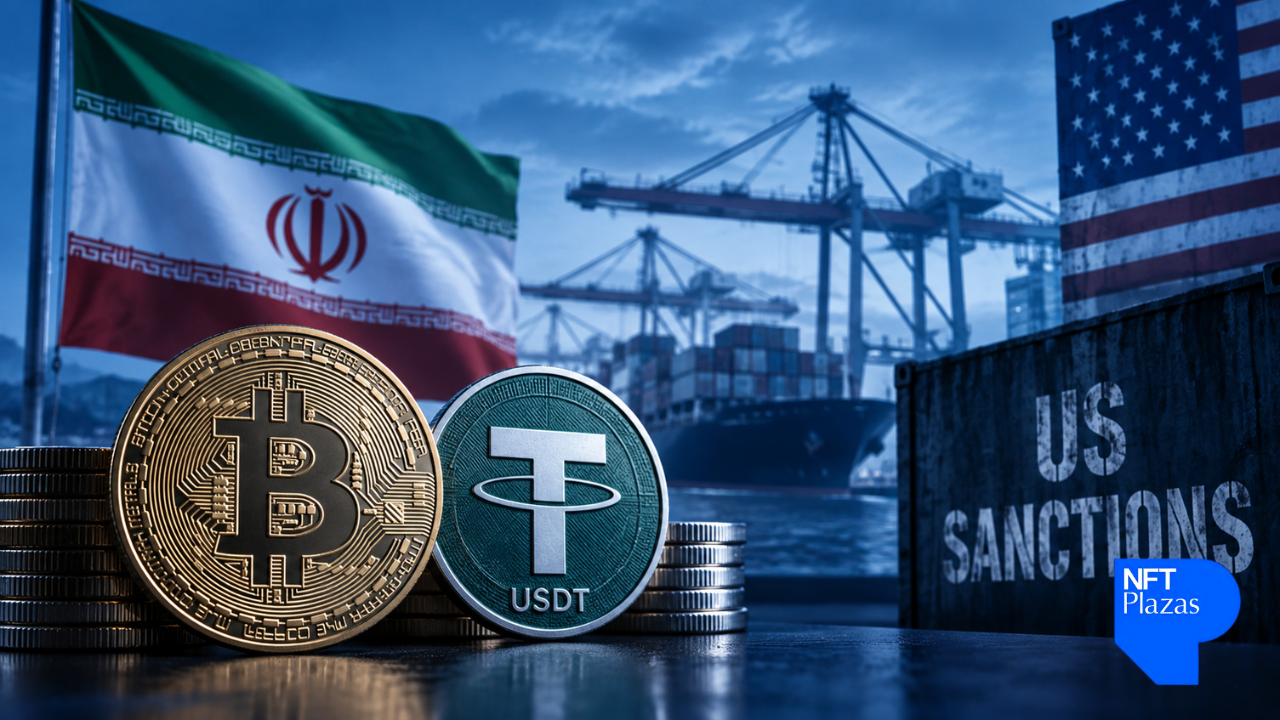
Iran is increasingly turning to cryptocurrencies including Bitcoin and Tether’s USDT to keep money moving across borders as tighter U.S. sanctions restrict the country’s access to the global financial system, according to a Financial Times report published Wednesday.
The reported shift marks a further expansion of cryptocurrency’s role in Iran’s shadow financial system. Iranian businesses have long used alternative channels to move foreign currency, but people familiar with the country’s trade and financial sector told the Financial Times that the central bank has recently relaxed some controls and quietly encouraged traders to repatriate overseas earnings by whatever means available.
That includes settling cross-border transactions through Iranian cryptocurrency exchanges, particularly using USDT, a stablecoin designed to track the value of the U.S. dollar, as well as Bitcoin.
The development comes as Washington intensifies economic pressure on Tehran. The U.S. has expanded sanctions against Iranian companies and intermediaries, while Treasury officials have warned that digital assets are increasingly being used by the Iranian regime to circumvent financial restrictions.


Iran is using crypto to bypass US sanctions
Crypto fills gaps left by the banking system
Iran has spent years operating outside much of the global financial system because of U.S. sanctions. The restrictions have made conventional international payments difficult, forcing businesses to rely on foreign-exchange houses, intermediaries and informal networks.
Under Iran’s previous foreign-currency system, exporters were required to return a large portion of their overseas earnings and sell the proceeds through a government-run platform at official exchange rates. Those rates were frequently less favorable than prices available on Iran’s open market.
The system created an incentive for companies to keep earnings abroad or bring money back through unofficial channels.
The Financial Times reported that Iranian authorities have recently become more flexible. Traders can exchange foreign currency through the open market and, in some cases, use export proceeds directly to finance imports instead of routing the funds through the official foreign-exchange system.
One business executive close to the regime told the newspaper that authorities were no longer focused on how funds were transferred, adding that receiving cryptocurrency for exports had become established practice.
Iranian authorities estimate that more than $100 billion in undeclared earnings is held domestically and overseas. The country’s General Inspection Organisation has separately said that more than 20,000 individuals and companies failed to meet obligations to return the equivalent of €94 billion in export proceeds.
The figures illustrate the scale of the problem facing Tehran: cryptocurrency is not replacing Iran’s financial system, but it offers another channel for moving value when conventional banking routes are constrained.
Why USDT matters
USDT is particularly useful for cross-border trade because it is designed to maintain a value close to the U.S. dollar without requiring access to the conventional dollar banking system.
For Iranian businesses dealing with unstable exchange rates and restrictions on dollar transactions, a dollar-linked digital asset can provide a relatively convenient way to transfer and hold value.
But the system is not beyond the reach of U.S. authorities.
Tether has previously frozen cryptocurrency held in wallets identified as being connected to Iranian authorities. The company froze hundreds of millions of dollars in USDT associated with Iranian-linked addresses after U.S. authorities identified the wallets.
U.S. regulators have also increasingly targeted the infrastructure supporting Iran’s crypto economy.
In June, the U.S. Treasury designated four Iranian cryptocurrency exchanges — Nobitex, Bit Pin, Wallex and Ramzinex — accusing them of facilitating sanctions evasion and other illicit financial activity. TRM Labs estimated that the four platforms represented roughly 78% of Iran’s attributed crypto volume in 2025, or about $7.7 billion.
In August, Treasury went further by sanctioning additional exchanges that it said were being used by Tehran to move billions of dollars and support the Islamic Revolutionary Guard Corps.
The pressure has not eliminated Iran’s crypto activity.
TRM Labs estimates that approximately $10 billion in cryptocurrency moved through Iran in 2025, compared with about $11.4 billion in 2024. The company says the persistence of those flows indicates structural demand rather than simply speculative trading.

2025 attributed crypto volume for the four OFAC-designated Iranian exchanges. (Source: TRM Labs)
Bitcoin mining adds another source of crypto revenue
Iran’s relationship with cryptocurrency also extends beyond trading and payments.
The country has become a significant Bitcoin mining hub, benefiting from relatively cheap domestic energy. Blockchain analytics firm Elliptic has estimated that Iran has accounted for around 4.5% of global Bitcoin mining activity, generating crypto assets that can potentially be used to purchase imports or move value outside conventional financial channels.
Mining provides Tehran with a way to obtain Bitcoin without directly purchasing it through international financial markets.
However, Bitcoin and stablecoins serve different purposes in Iran’s economy. Bitcoin can function as a store of value and a transferable asset, but its price volatility makes it less convenient for routine commercial settlement. USDT, by contrast, is designed to remain close to the dollar, making it more practical for businesses that need predictable pricing.
Washington is targeting crypto alongside traditional finance
The growing role of cryptocurrency has placed digital assets firmly within the U.S. sanctions campaign against Tehran.
OFAC has stated that Iranian digital-asset exchanges can fall under existing sanctions on Iranian financial institutions, meaning U.S. persons and financial institutions may be prohibited from dealing with their assets.
The U.S. is also signaling that further action could follow. Treasury Secretary Scott Bessent said last week that digital assets could become additional targets as Washington expands its campaign to pressure Iran’s economy.
That creates a difficult balance for Iranian authorities. Crypto can provide businesses with an alternative route around restricted banking channels, but every additional transaction creates an on-chain record that can potentially be traced by blockchain analytics firms.
Iran’s experience therefore highlights both the strength and limitation of cryptocurrency under sanctions.
Digital assets can move across borders without relying directly on correspondent banks or conventional payment networks. Yet exchanges, stablecoin issuers, wallets and intermediaries remain vulnerable to sanctions, freezes and enforcement actions.
For Tehran, the objective appears less about replacing the traditional financial system than keeping enough alternative channels open to prevent sanctions from completely cutting the economy off from international trade.
As U.S. pressure intensifies, cryptocurrency is becoming one of those channels — alongside foreign-exchange houses, offshore intermediaries and informal trading networks.
The result is a financial system increasingly pushed underground, where Bitcoin and USDT are becoming tools for maintaining trade and moving money when conventional channels are no longer reliable. As one Tehran-based economist told the Financial Times, the deeper Iran’s economy moves underground, the greater the need for cryptocurrency.