


With the rise of Layer 2 networks like Arbitrum One and Arbitrum Nova, the Arbitrum gaming NFT ecosystem makes transactions faster, cheaper, and more reliable, allowing NFTs to function as true gameplay assets rather than mere collectibles.
If you’re exploring the NFT gaming ecosystem, this article highlights key gaming projects, marketplaces, and infrastructure powering Arbitrum GameFi. We also show how it shapes player engagement, token utility, and future growth potential, and how it compares with other blockchain gaming networks.
Best Arbitrum Gaming NFT Projects to Watch in 2026
The Arbitrum gaming and NFT ecosystem has shown rapid growth, driven by its high-performance Layer 2 (L2) solutions and the adoption of Orbit-based Layer 3 (L3) networks. Here are the top Arbitrum gaming NFT projects to watch in 2026:
Arbitrum-Powered NFT Games
Games on Arbitrum One and Arbitrum Nova support item crafting, PvP battles, and NFT-based upgrades at scale, making high-frequency gameplay economically viable. Several projects stand out due to active communities, integrated marketplaces, and high on-chain activity. Below are some of the major Arbitrum-Powered NFTs games:

ProjectDescriptionKey FeaturesToken/NFTsBig TimeMultiplayer action RPG with dungeon exploration and loot collectionCross-game NFT equipment, PvE/PvP mechanics, high-resolution graphicsTIME token, in-game NFT gearPirate NationOn-chain pirate RPG on Arbitrum Nova/Apex with PvP and collectible-driven gameplayFully on-chain characters, real-time battles, player-owned progressionPirate NFTs, in-game assetsBattleFlyStrategy-based auto-battler integrated with the Treasure ecosystemDAO governance, staking mechanics, play-to-earn rewardsBattleFly NFTs, MAGIC tokenSpartadexGamified decentralized exchange combining NFT trading and gameplayNFT staking, exchange-integrated rewards, leaderboard competitionSpartadex NFTs, platform tokenThe BeaconUpcoming RPG with a large community and Epic Games Store integrationCommunity-driven beta, NFT-based progression, guild featuresBeacon NFTs, in-game currency
Arbitrum GameFi Ecosystem
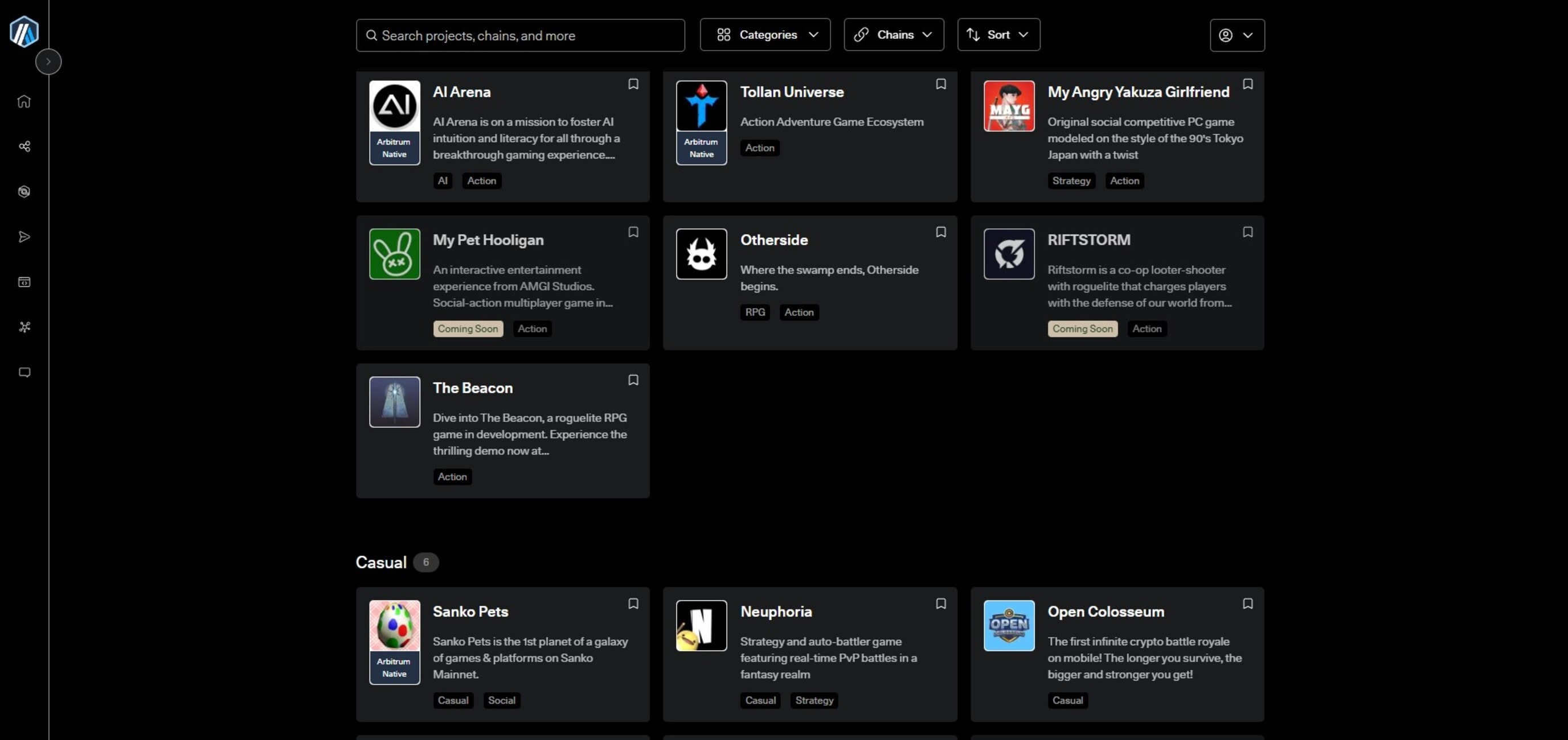
The Arbitrum GameFi ecosystem is the financial and infrastructure layer that supports blockchain gaming on the Arbitrum network. It merges gameplay with decentralized finance, allowing players to earn real value through NFTs, in-game tokens, staking, and yield-generating mechanics.
This ecosystem includes DAO-governed gaming studios, tokenized reward systems, decentralized marketplaces, and liquidity protocols that connect in-game assets with broader DeFi networks.
Players can stake Arbitrum-based tokens such as MAGIC or platform-native currencies to unlock features, participate in governance, or earn yields tied to game activity. Game developers benefit from Arbitrum’s scalable Layer 2 and Layer 3 infrastructure, low transaction fees, and Ethereum compatibility, which reduces the complexity of building high-frequency GameFi applications.
Meanwhile, ecosystem initiatives like Treasure DAO and Orbit chains provide funding, shared liquidity, and modular frameworks for new games and NFT economies. Together, these components support Arbitrum in being a leading hub for sustainable, token-driven GameFi innovations.
Top Arbitrum NFT Marketplaces for Gaming
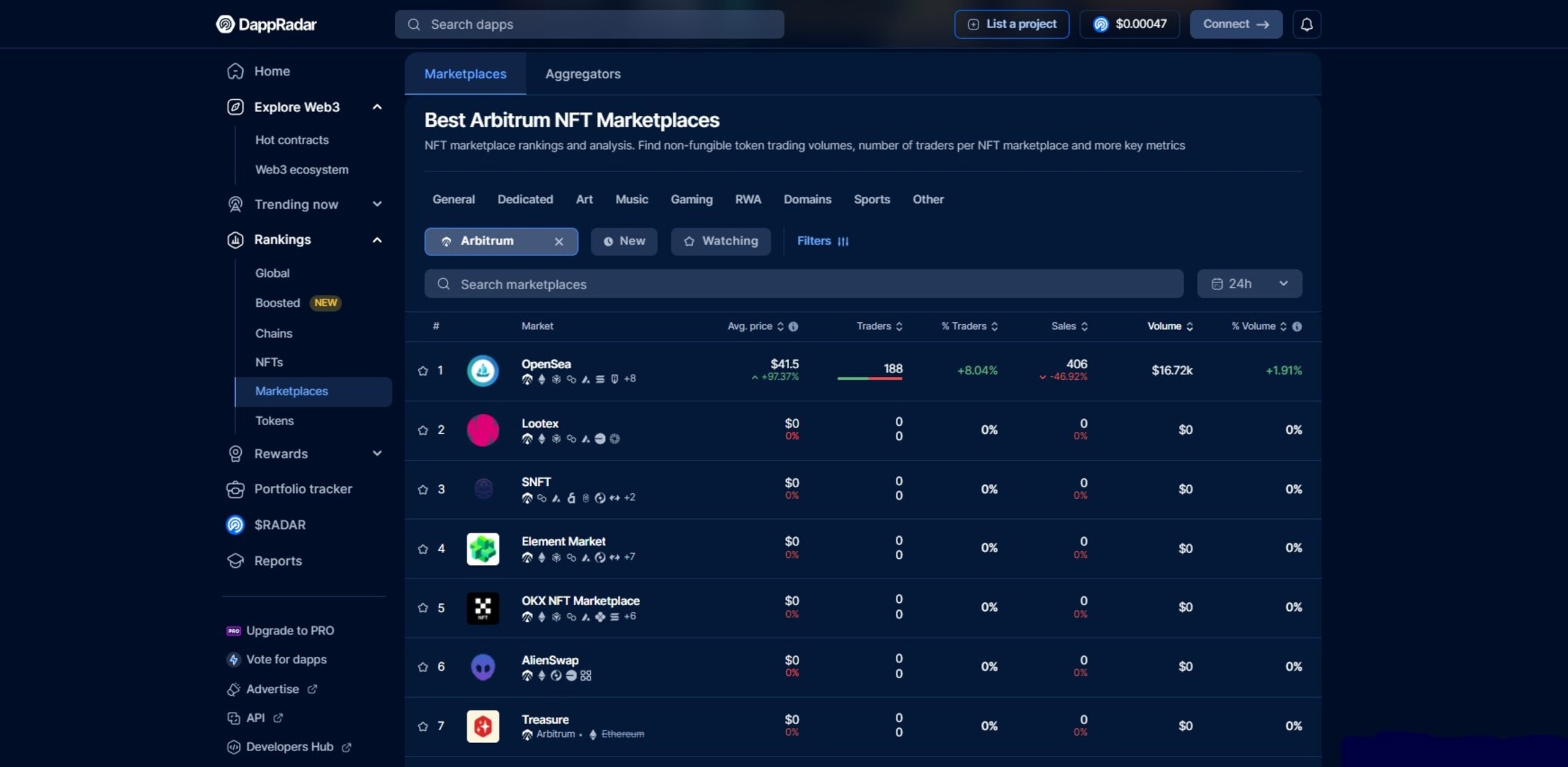
NFT marketplaces are the backbone of Arbitrum’s gaming ecosystem, providing liquidity, trading, and distribution channels for in-game assets such as characters, equipment, land, and collectibles. Multi-chain platforms like OpenSea support Arbitrum-native NFTs, enabling minting, listing, and secondary-market trading with reduced fees and fast confirmations.
Smart contracts on these platforms enforce royalty payments, verify asset authenticity, and enable trustless peer-to-peer transfers, ensuring secure and transparent NFT ownership. Specialized marketplaces also strengthen in-game economies by prioritizing utility over speculation.
Platforms like Treasure Marketplace and Smolverse integrate directly with gameplay dashboards, enabling players to acquire, upgrade, or trade assets without leaving the game. Meanwhile, cross-chain marketplaces such as OKX NFT Marketplace expand liquidity and exposure for Arbitrum gaming NFTs, connecting them to a broader digital asset ecosystem.
What Is Arbitrum?
Arbitrum is the leading Layer 2 scaling solution that uses optimistic rollups to dramatically expand blockchain capacity while preserving core security guarantees. The network enables developers and users to run high-volume, decentralized applications such as gaming, DeFi, and NFT trading at a fraction of the cost of mainnet.
This architecture relies on sequencer networks, fraud-proof dispute systems, and customizable Orbit Layer 3 chains, all of which connect Layer 2 activity seamlessly back to Ethereum’s settlement layer. Rather than competing as a separate blockchain, Arbitrum acts as an efficiency multiplier, enabling assets and logic to gain practical utility across scaled environments.
Supporting this growth, initiatives such as the ARB DAO treasury, Gaming Catalyst Program, and dedicated gaming funds provide grants, shared infrastructure, and modular tooling to encourage sustainable development.
The network also has a native token, ARB, with a market cap of approximately $1.23 billion and a price of around $0.21. It also has a circulating supply of 5.83 billion tokens. Meanwhile, its DeFi TVL stands at about $2.91 billion, reflecting assets locked in protocols on the chain, alongside a stablecoin market cap of $3.46 billion.
Arbitrum Gaming vs Other Blockchain Gaming Platforms
Arbitrum saw 68% year-over-year growth to 119 Web3 gaming titles by late 2024, largely via Orbit’s 23 new networks. It ranks high in dApp activity, with $141.57 million in transaction volume alongside Ethereum’s lead, and web3 games accounting for 28.3% of 1.5 million daily active users across chains.
Over 600,000 monthly users engage with the network, supporting high-volume gaming transactions. However, you can see a similar, if not better, adoption trend with other chains, such as the SUI gaming NFT ecosystem and the Ethereum gaming NFT ecosystem. For better insight, let’s explore how Arbitrum gaming compares with other blockchain gaming platforms.
Arbitrum vs Sui
FeatureArbitrumSuiTypeEthereum Layer 2Layer 1 BlockchainActual TPS6,000+10,000Maximum TPS40,000297,000Fees$0.01, gasless gaming$0.001 nativeGaming TVL$3B+$300M+Ecosystem30+ Orbit games, Stylus RustEarly Move-based gamesNFT SupportERC-721/1155 nativeObject-centric modelTransaction SpeedFast confirmations with rollup scalingHigh throughput with parallel executionMaturity3+ years, $18B TVL1 year, rapid growthSecurity ModelInherits Ethereum securityIndependent validator networkNFT CompatibilityFull ERC-721 and ERC-1155 support Native object-based NFT model
Arbitrum vs Ethereum
FeatureArbitrum Ethereum TPS22x higher max TPS15-30 TPSBlock Time 250ms12 secondsNetwork LayerLayer 2 scaling solutionBase Layer 1 blockchainTransaction FeesSignificantly lower gas feesHigh gas fees during congestionGaming ScalabilityOptimized for high volume gaming activityLimited scalability for real-time gamesSecuritySecured by EthereumNative base layer securityDeveloper toolStylus + EVMSolidity onlyTVL$18B$60B+ L1
How to Get Started With Arbitrum Gaming Projects
Below are ways you can get started in Arbitrum’s gaming NFT ecosystem, from setting up a wallet to bridging funds, exploring games, and participating in communities to build valuable in-game assets.
Set Up a Compatible Wallet: Choose an Ethereum-compatible wallet such as MetaMask that can interact with Arbitrum Layer 2 and Layer 3 networks, ensuring full support for NFT transactions and GameFi operations.Bridge Funds to Arbitrum: Transfer ETH or other tokens from the Ethereum mainnet to Arbitrum One, Nova, or gaming-focused Orbit chains to enable instant transactions.Explore NFT Games: Access supported Arbitrum gaming titles to mint or purchase in-game NFTs, participate in play-to-earn mechanics, and experience real-time asset ownership that flows across multiple games.Trade and Manage Assets: Use NFT marketplaces like OpenSea, Treasure Marketplace, or Smolverse to buy, sell, or upgrade gaming assets while taking advantage of built-in liquidity and low transaction costs.Engage With Communities: Join official Discords, forums, and governance channels to stay updated on game developments, NFT drops, and ecosystem proposals, while connecting with other players and developers.Leverage GameFi Mechanics: Stake tokens, earn rewards, and participate in DAO governance to maximize utility and yield from gaming NFTs while contributing to the broader ecosystem economy.
Finally, track Arbitrum network upgrades, Layer 3 launches, and project announcements to optimize performance, maintain security, and identify new opportunities in gaming and NFT markets.
Arbitrum’s Role in Web3 Gaming
Arbitrum plays a pivotal role in Web3 gaming as an Ethereum Layer-2 solution, offering low fees, high throughput, and tools like the Orbit Framework for custom Layer-3 chains tailored to games.
Its Gaming Catalyst Program (GCP) and Gaming Ventures initiative provide grants and investments—such as a $10 million first wave from a 200 million ARB ($65 million) fund—to support developers building on-chain games. These efforts have driven ecosystem growth, positioning Arbitrum as a leader for mass-scale gaming adoption
Here, we explore the network’s scalability edge, specialized tools like Arbitrum One, Arbitrum Nova, and Arbitrum Orbit, plus innovations such as Stylus, all designed to enhance player immersion.
Scalability & Cost-Efficiency
Arbitrum scales Ethereum through optimistic rollups that bundle thousands of transactions off-chain for secure settlement, reducing fees to mere pennies while achieving 40,000 TPS. This enables gamers to execute in-game actions, NFT trades, and loot drops instantly without network congestion.
Developers can predict costs in advance, avoiding volatile gas spikes that would otherwise impact profitability in high-player titles. As a result, block times drop to 250 milliseconds, matching traditional servers for real-time PvP battles or live events. The predictable, low-cost structure allows studios to implement free-to-play entry with optional NFT upgrades, onboarding new players without friction.
Specialized Infrastructure
Arbitrum supports specialized chains like Arbitrum Nova, optimized for high-volume, low-cost gaming, and uses Data Availability Committees to reduce fees. It also provides tools through Arbitrum Orbit for creating custom “game rollups” that handle game-specific logic and microtransactions efficiently.
This setup ensures that high-frequency gameplay and NFT interactions remain smooth without congestion or unpredictable costs. Together, Arbitrum Orbit and Nova give developers a flexible, scalable infrastructure for both indie and AAA blockchain games.
Arbitrum Orbit: Custom Layer 3 Chains for Gaming
Arbitrum Orbit allows developers to create custom Layer 3 chains for gaming, optimized for high-frequency transactions and NFT interactions. Each chain operates independently yet remains interoperable with Arbitrum One and Nova, enabling seamless asset flow across the ecosystem.
Developers can configure throughput, fees, governance, and data layers to ensure smooth performance for competitive, large-scale games. By isolating computation-heavy workloads at the L3 level, Orbit chains reduce congestion on parent networks and maintain consistent, low-latency gameplay.
This design is already being applied in production. Xai, for example, leverages Arbitrum Orbit to support AAA-style Web3 gaming with fast settlement and low fees. Sanko Network also uses Orbit to build a creator- and community-driven gaming ecosystem with its own economic and governance parameters.
Underneath all these, Arbitrum Orbit is powered by the Arbitrum Nitro stack, which ensures high scalability, full EVM compatibility, and efficient transaction compression. Support for Stylus further expands development flexibility by enabling smart contracts in Rust and C++ alongside Solidity, often at lower gas costs.
Developers can also choose between AnyTrust and traditional rollup data models, allowing them to balance cost efficiency, security, and privacy based on application needs.
Arbitrum Stylus
Arbitrum Stylus introduces a second virtual machine to the Arbitrum stack, enabling smart contracts to run in WebAssembly (WASM) alongside traditional EVM contracts. This allows developers to write contracts in languages like Rust, C, and C++, leveraging decades of optimized compiler toolchains for efficient execution.
Stylus contracts execute faster and consume less gas for memory- or compute-intensive operations, making them ideal for on-chain games, DeFi, and generative applications. Fortunately, Stylus contracts remain fully interoperable, allowing hybrid applications to call between EVM and WASM seamlessly.
Stylus programs undergo coding, activation, execution, and fraud-proofing, ensuring security and determinism while maintaining Ethereum-level guarantees. During activation, WASM code compiles to native machine code with precise metering for safe and predictable operations.
Developers can port existing Rust, C, or C++ applications or optimize parts of Solidity contracts without rewriting from scratch. By combining high performance, low costs, and interoperability, Stylus enhances Arbitrum’s appeal as a developer-friendly platform for Web3 gaming and high-performance dApps.
Enhance User Experience
Arbitrum improves gameplay by making blockchain interactions seamless, so players experience instant transactions without waiting. Simplified wallet connections and embedded accounts let new users join games quickly, reducing onboarding friction.
With gasless actions on Orbit chains, players can focus on strategy and progression instead of worrying about fees. They can also use the analytics dashboards to track in-game assets across titles, giving players a clear overview of their NFTs and tokens.
Aside from that, integrated social features, such as leaderboards, guilds, and chat systems, keep communities engaged around shared achievements. While mobile SDKs and offline caching maintain smooth gameplay even on limited network connections, making games accessible anywhere.
Risk and Challenges of Arbitrum Gaming NFT Ecosystem
Below are the main risks and challenges developers and players face in Arbitrum’s gaming NFT ecosystem.
Cross-Chain and transaction risks: Moving assets across Arbitrum One, Nova, Orbit, or Ethereum can cause delays or failed transfers, affecting gameplay and NFT liquidity.Security vulnerabilities: Orbit chains and AnyTrust models reduce costs but may create potential attack vectors that compromise in-game assets or smart contracts.Economic and market risks: NFT price volatility and speculative trading can destabilize game economies, impacting token value and player incentives.Technical and adoption barriers: Stylus, multiVM environments, and custom Layer 3 rollups demand experienced developers, slowing adoption for smaller studios or indie projects.
The Future Trends of Gaming on Arbitrum
Arbitrum improves Web3 gaming with 250ms block times and over 6,000 TPS, which allows large player activity while securing $18B in assets. This performance enables ERC‑721 and ERC‑1155 NFTs that give players real ownership of items across games. That ownership becomes more powerful through Stylus, which supports Rust, C++, and Solidity for advanced gameplay logic.
This technical base then attracts Web2 studios seeking smoother blockchain integration. Because studios onboard faster, wallets like Session and Wildcard simplify access through email or social login.
This easy entry connects players to DeFi tools such as Uniswap, Aave, and GMX for in-game earning. Games like Otherside and Golden Tides demonstrate these connected economies. This growth then creates demand for scalable gaming infrastructure.
To meet this demand, Orbit-powered Layer 3 chains provide custom gaming rollups. These chains support cross-game assets and VR experiences. Governance through DAOs organizes communities and marketplaces. Together, these systems position Arbitrum as a long-term gaming foundation.
Conclusion
Arbitrum’s ecosystem enables fast, low-cost, and secure gaming experiences, letting players truly own and trade NFTs across multiple titles. The combination of Stylus, Orbit-powered Layer 3 chains, and wallet integrations empowers developers to create immersive, real-time, and interconnected gameplay.
These features support sustainable P2E models and vibrant in-game economies while attracting both indie and AAA studios. Ultimately, Arbitrum delivers a flexible, scalable, and player-focused infrastructure that enhances engagement, ownership, and long-term growth in Web3 gaming.
FAQs
What is the best Arbitrum gaming NFT to buy in 2026?
The best NFT depends on your goals. However, some of the top options include Treasure DAO, which historically dominates Arbitrum’s gaming NFT space, accounting for over 95% of network gaming transactions. Other options are Pirate Nation and Spartadex. The first offers fully on-chain pirate-character NFTs, while the latter combines gaming with exchange mechanics and boasts a high number of active wallets.
Are Arbitrum gaming NFTs better than Ethereum gaming NFTs?
It depends on your priorities and the type of game you want to play. Arbitrum NFTs offer faster transactions, lower fees, and smoother gameplay for high-volume games, while Ethereum NFTs benefit from a larger community, broader marketplaces, and stronger long-term liquidity. Choosing the better option depends on whether you value speed and affordability or ecosystem size and established credibility.
Is it safe to invest in Arbitrum NFTs?
Yes, investing in Arbitrum NFTs can be safe if you research the game, the developers, and the NFT’s utility. The platform benefits from Ethereum-level security and audited smart contracts, but market risks still exist.
Can you really earn money playing NFT games?
Yes, it is possible to earn money playing NFT games, but income depends on the game’s economy, your skill, and strategy. Play-to-earn models allow players to earn NFTs, tokens, or other rewards that can be sold or staked.


