South Korea is taking another significant step toward integrating cryptocurrencies into its financial system. Just weeks after proposing a crypto tax delay until 2029, the country has unveiled a comprehensive legislative proposal that could reshape its digital asset industry.
The South Korea crypto bill, presented on November 24, introduces a framework covering stablecoins, cryptocurrency exchanges, digital asset issuance and investor protection.
While the legislation still requires parliamentary approval, its introduction represents an important milestone in Asia’s evolving cryptocurrency landscape.

Could greater regulatory clarity help Bitcoin attract a new generation of institutional investors?
South Korea Crypto Bill Introduces Major Industry Changes
South Korea’s Financial Services Commission has outlined a regulatory framework designed to improve market transparency while encouraging digital asset innovation.
One of the most significant proposals concerns cryptocurrency exchange ownership.
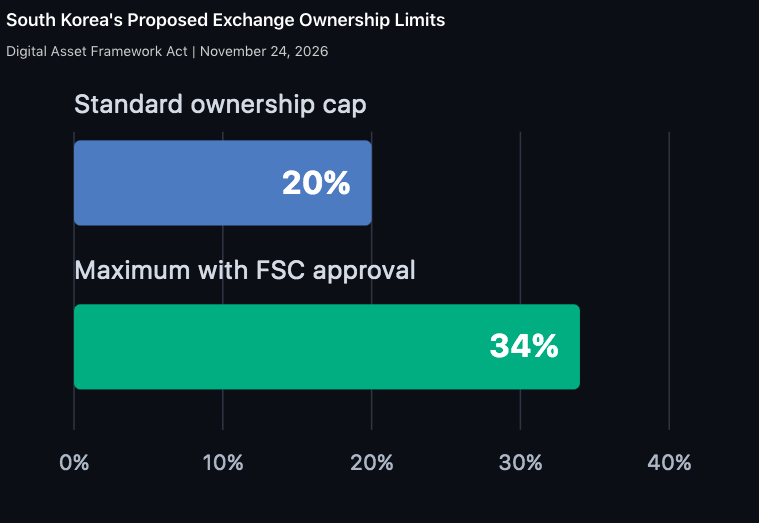
Under the proposed legislation, major shareholders would generally be limited to a 20% ownership stake, with exceptions allowing ownership of up to 34% following regulatory approval.
The measures could create a more diversified ownership structure across domestic trading platforms.
However, ownership restrictions could also create challenges for established businesses. The effectiveness of the framework will depend on how regulators balance market competition with financial innovation.
South Korean Banks Could Enter The Stablecoin Market
Perhaps the most interesting development is the proposed introduction of regulated Korean won-backed stablecoins.
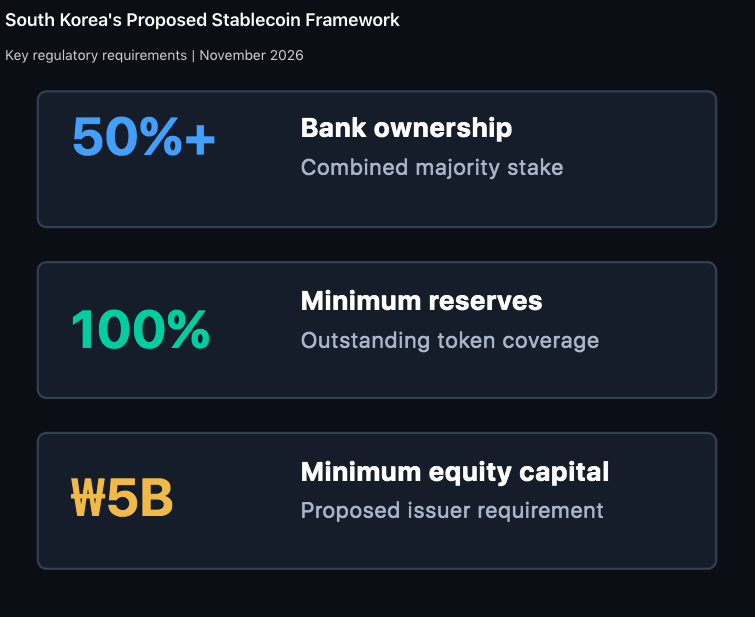
The legislation would initially allow bank-led consortiums to issue stablecoins, provided banks collectively maintain majority ownership.
Issuers would also need to maintain reserves covering at least the entire value of outstanding tokens.
As we previously reported, KB Financial completed a stablecoin pilot earlier this year, demonstrating growing interest in blockchain-based financial services.
The emergence of regulated digital payment infrastructure could indirectly benefit Bitcoin by making blockchain-based transactions more familiar to traditional financial institutions.
However, stablecoin adoption does not automatically translate into Bitcoin purchases.
Asia Is Accelerating Its Cryptocurrency Regulatory Efforts
Cryptocurrency commentator Conor Kenny recently highlighted South Korea’s legislative progress, comparing the country’s developing framework with cryptocurrency market structure efforts in the United States.
BREAKING: 🇰🇷 South Korea announces plans to unveil a major crypto law tomorrow.
Asia is moving ahead with its own CLARITY Act while the U.S. is falling behind! 🚀
— Conor Kenny (@conorfkenny) November 23, 2026
The comparison highlights growing international competition to establish clear rules for digital assets.
As South Korea advances its regulatory framework, financial institutions could gain greater confidence in developing cryptocurrency-related products and services.
The latest proposal would also allow domestic initial coin offerings under disclosure requirements, potentially creating new opportunities for blockchain entrepreneurs.
What Could South Korea’s Crypto Bill Mean For Bitcoin?
Earlier this year, South Korea also advanced its tokenized securities framework, reflecting a broader effort to integrate blockchain technology into traditional finance.
We believe these developments are particularly relevant to Bitcoin’s long-term adoption.
Regulatory uncertainty has historically represented a barrier for financial institutions considering cryptocurrency exposure. Clearer operating standards could reduce some of that uncertainty.
Furthermore, stronger custody requirements and enhanced customer protections could improve confidence among investors who have previously remained cautious about digital assets.
Nevertheless, the proposed exchange ownership restrictions and bank-centered stablecoin model could limit participation from smaller companies.
Could South Korea Become Asia’s Next Crypto Powerhouse?
South Korea’s legislative progress demonstrates that cryptocurrency regulation is increasingly evolving beyond restrictions and toward structured financial integration.
For Bitcoin, the long-term opportunity could lie in the development of trusted infrastructure that connects traditional financial institutions with digital asset markets.
While the legislation does not guarantee increased Bitcoin demand, a more transparent market could establish favorable conditions for broader adoption.
The next important milestone will be parliamentary deliberation.
Should the proposed framework successfully balance innovation with investor protection, South Korea could strengthen its position within Asia’s increasingly competitive digital asset economy.

Editorial Process for bitcoinist is centered on delivering thoroughly researched, accurate, and unbiased content. We uphold strict sourcing standards, and each page undergoes diligent review by our team of top technology experts and seasoned editors. This process ensures the integrity, relevance, and value of our content for our readers.