

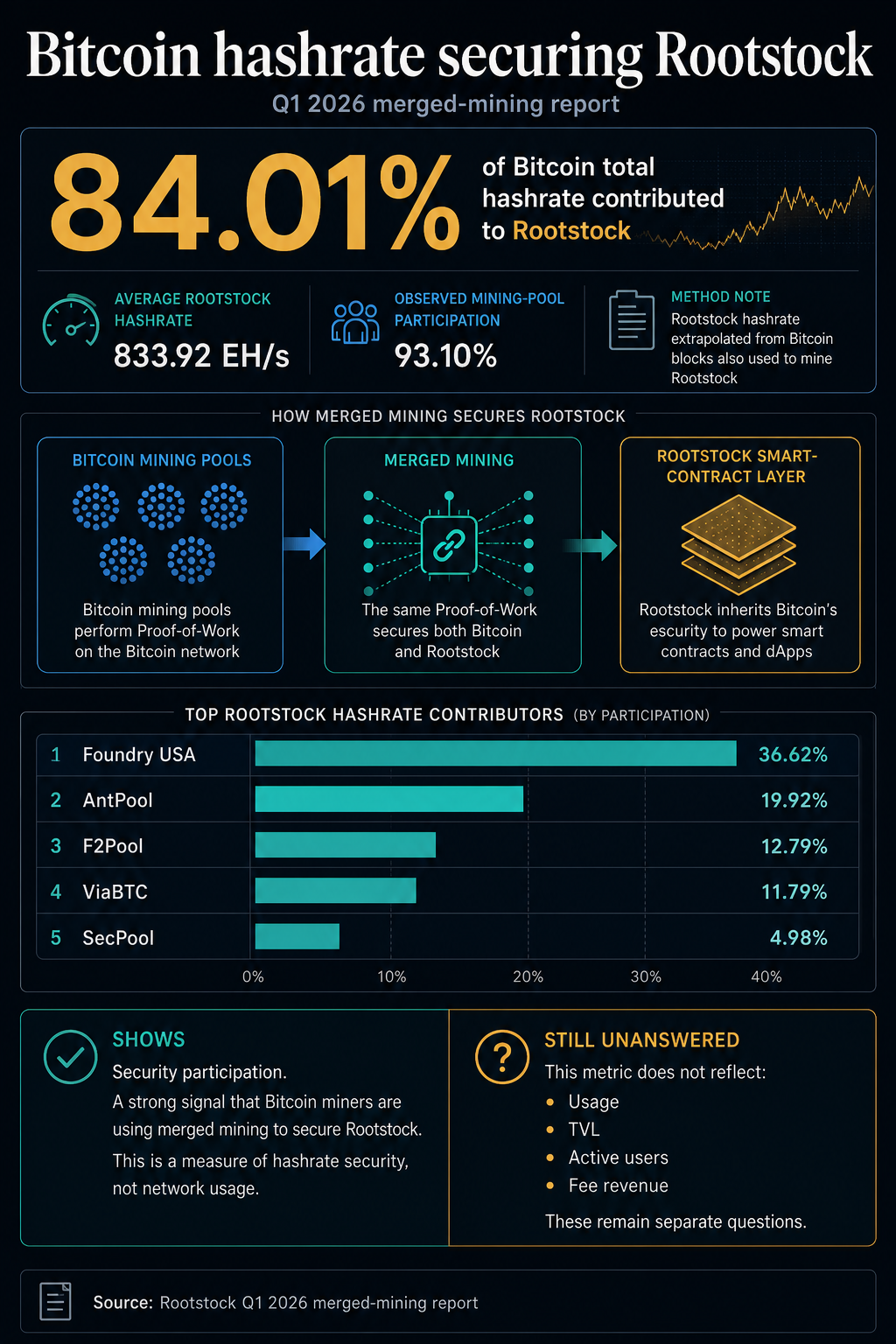
Bitcoin miners are already doing more than securing Bitcoin’s base chain. According to Rootstock’s Q1 2026 merged-mining report, 84.01% of Bitcoin’s total hashrate contributed to securing Rootstock during the quarter, giving Bitcoin DeFi a hashrate-backed security claim.
The network averaged 833.92 EH/s of Rootstock hashrate.
The number is striking because Rootstock sits beside Bitcoin rather than competing for a separate set of machines. It is a Bitcoin sidechain that uses merged mining, allowing Bitcoin mining pools to submit work to Rootstock while continuing to mine Bitcoin.
In Rootstock’s framing, miners can earn additional BTC-denominated rewards from Rootstock network fees without adding hardware or interrupting their Bitcoin operations.

Precision matters. The metric tracks hashrate contributed through mining pools rather than individual miners’ intent, leaving DeFi demand unanswered.
It shows that a large share of Bitcoin’s hashpower, as measured by Rootstock’s Q1 methodology, was also being used to secure a Bitcoin smart-contract layer.
That turns the report into a signal for mining and Bitcoin DeFi infrastructure. Bitcoin DeFi, often called BTCFi, is the broader category that Rootstock is trying to secure through merged mining.
The next signal is whether that security becomes meaningful fee revenue, liquidity, and user activity.
What the hashrate number means for Bitcoin DeFi
Merged mining allows a miner to mine more than one compatible proof-of-work chain at the same time. CryptoSlate’s own glossary defines merged mining as mining more than one cryptocurrency without sacrificing hash rate.
In Rootstock’s case, the practical claim is that Bitcoin miners can reuse their existing infrastructure to secure Rootstock while remaining focused on Bitcoin.
Rootstock said 93.10% of observed mining-pool hashrate participated in merged mining during Q1. Its full report lists Foundry USA, AntPool, F2Pool, ViaBTC, and SecPool among the largest contributors to Rootstock’s securing hashrate.
Foundry USA accounted for 36.62% of Rootstock’s reported distribution, followed by AntPool at 19.92%, F2Pool at 12.79%, ViaBTC at 11.79%, and SecPool at 4.98%.
Mining-pool participation determines whether merged mining remains a niche technical option or becomes a security layer backed by major Bitcoin infrastructure.
A chain secured by a small pool of marginal hashpower carries a different risk profile from one receiving work from pools that already sit near the center of Bitcoin mining.
Rootstock’s Bitcoin hashrate data uses blockchain.com seven-day averages, and that Rootstock hashrate is extrapolated from the share of Bitcoin blocks also used to mine Rootstock blocks.
That methodology makes the number a security-participation metric. Wallet usage, lending activity, trading volume, and protocol revenue require separate measures.
What the figure showsWhat remains unansweredA large share of Bitcoin hashrate contributed to Rootstock security in Q1.Whether individual miners made separate Rootstock decisions.Major Bitcoin mining pools were part of the Rootstock security base.How much each pool or miner earned from Rootstock fees.Bitcoin proof-of-work is already being reused to secure smart-contract infrastructure.DeFi usage, TVL, active users, and product-market fit.
Hashrate explains the security floor, while fees and usage explain whether that floor becomes valuable for the broader Bitcoin economy.
Pool distribution also belongs near the top of the discussion. A high headline ratio can conceal concentration, and Rootstock’s own table shows the security base depends heavily on a small group of large pools.
Why miners may care now
Bitcoin mining margins have come under pressure. CoinShares’ Q1 2026 Bitcoin mining report described Q4 2025 as the toughest quarter for miners since the April 2024 halving.
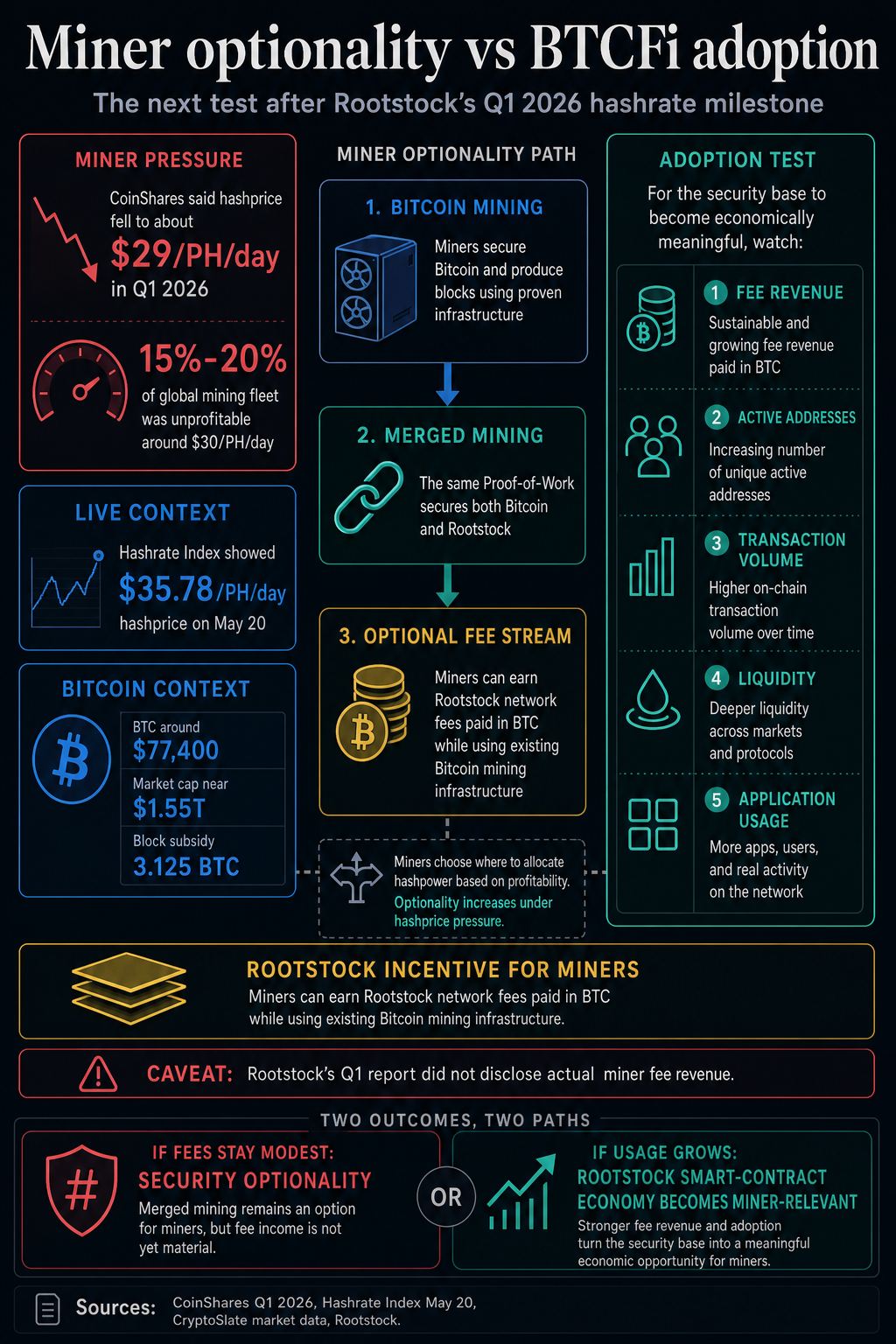
The firm said hashprice was compressed by Bitcoin’s late-2025 price decline and high network competition. It fell further to about $29 per PH/day in Q1, and CoinShares estimated that 15% to 20% of the global mining fleet was unprofitable at around $30 per PH/day.
Hashrate Index has hashprice at $35.78 per PH/day, and Bitcoin network hashrate at 984.34 EH/s.
CryptoSlate market data shows BTC trading around $77,300 with a market cap near $1.55 trillion, while its market rankings placed Bitcoin dominance at 60.1%.
At that price, the 3.125 BTC block subsidy remains the core mining reward. Additional fee streams become easier to understand in business terms when miners are managing hardware refreshes, power costs, treasury sales, and AI or high-performance computing opportunities.
Rootstock’s pitch to miners is that a pool can add another fee source while using the same proof-of-work. That is a modest claim, but it is also why the Q1 hashrate figure is more broadly relevant.
Merged mining gives Bitcoin miners an option on BTCFi fee growth while keeping their main operation anchored to Bitcoin.
For BTC holders, the implication is different. If miners can secure Bitcoin-native smart-contract infrastructure without redirecting hashpower away from Bitcoin, then part of the BTCFi stack is already attached to Bitcoin’s economic engine.
The security base exists before the market has settled on how valuable that infrastructure will become.
The Q1 number lands first as optionality for miners, then as a challenge for builders: convert a strong security base into regular economic activity.

The income effect remains unquantified. Merged mining can make sense even when fees are small because the incremental operational burden is limited, according to Rootstock’s mechanics, but materiality still depends on actual fee flow.
Where security has to turn into usage
Hashrate can rise faster than usage. Messari’s State of Rootstock Q1 2025 report showed that Rootstock’s merged-mining participation averaged 81% in that quarter after the integration of Foundry and SpiderPool.
In the same report, Messari recorded weaker user metrics, including lower active addresses, lower new addresses, and a decline in DeFi TVL.
That earlier split is the key caveat for the new Q1 2026 figure. High participation in merged mining can make a network harder to attack, while borrowers, traders, stablecoin liquidity, and developers determine whether the secured network becomes economically active.
Security is a prerequisite for financial activity, while fee revenue and usage show whether people are using the rails.
The available Q1 2026 mining report leaves the most important miner-economics number outside the table: actual Rootstock fee revenue to miners.
Rootstock says rewards are paid in Bitcoin from network fees, but the Q1 mining report focuses on hashrate participation and pool distribution rather than a miner revenue breakdown.
The small scale of Rootstock’s token economy reinforces that caveat. CryptoSlate market data shows rBTC, the Bitcoin-pegged asset used on Rootstock, with a market capitalization of about $19.9 million. RIF, the Rootstock Infrastructure Framework token, is larger at about $74.4 million, but still modest by crypto-sector standards.
Together, those figures show that Rootstock’s security footprint is much larger than the market value currently attached to its core ecosystem assets.
Rootstock has shown that most Bitcoin hashrate can secure BTCFi infrastructure through merged mining. But it still needs activity and fee data to show that the infrastructure is becoming economically important for miners and BTC holders.
The next test is economic. If Rootstock fee revenue, active addresses, transaction volume, liquidity, and application usage remain modest, merged mining will look like valuable optionality for miners and a security feature for users.
If those metrics grow alongside sustained mining-pool participation, the argument changes: Bitcoin’s hashrate would be helping miners earn from a real Rootstock smart-contract economy secured through merged mining.
For now, Rootstock’s 84.01% figure gives Bitcoin DeFi a stronger infrastructure claim. It shows that a Bitcoin smart-contract layer can sit on top of a large share of Bitcoin’s mining work while miners continue their main business.
The harder part is converting that security headline into enough activity and fees for miners and BTC holders to care beyond the hashrate number.