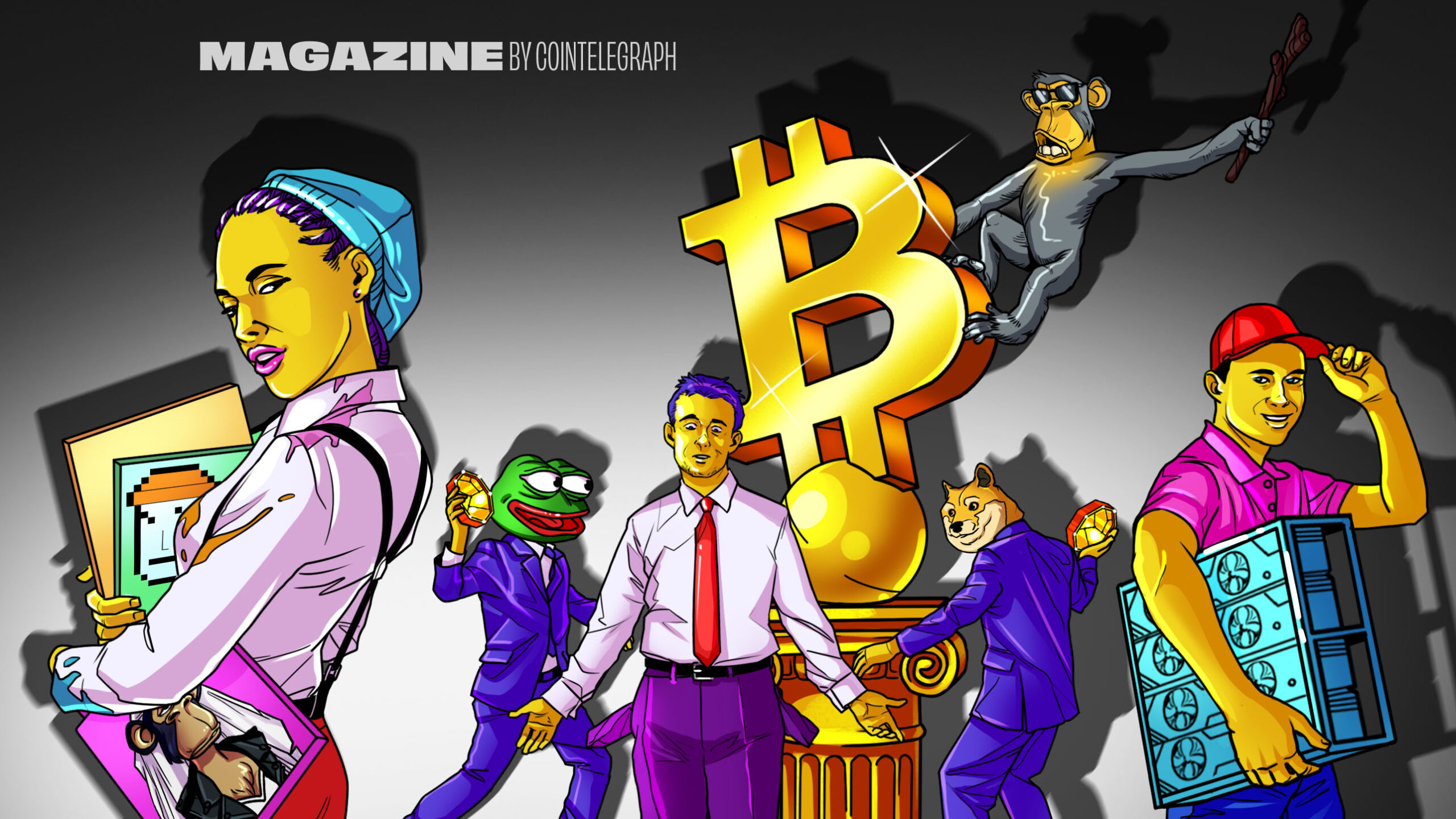
The launch of BRC-20 tokens and Ordinals NFTs on Bitcoin has transformed the No. 1 blockchain overnight into a clunkier version of Ethereum.
The core developers and miners who signed off on the network’s Taproot upgrade in November 2021 never envisaged this would be the result. Bitcoin now suffers from many of the same problems that have bedeviled Ethereum for years, including scammy memecoins and shitcoins, NFTs of monkey pictures hogging block space and skyrocketing transaction fees.
The network is even having to deal with incidences of miner extractable value (MEV), whereby miners profit by reordering pending transactions.
“I’m kind of upset at myself for not realizing,” says Quantum Economics founder Mati Greenspan, a Bitcoiner since 2013.

“It took these guys starting to hype up JPEGs on Bitcoin until I was like: ‘Oh shit, what did we just do?’” He laughs ruefully.
Some Bitcoiners on Bitcointalk and Twitter refer to the impact of Ordinal NFTs and BRC-20 tokens as an attack on Bitcoin, an exploit of Taproot, or simply as spam clogging up the network.
It’s sparked a fierce debate over whether unexpected outcomes are precisely the sort of outcomes you should expect from a permissionless protocol, or whether something needs to be done to get rid of them.
Why are Bitcoin fees so high?
BRC-20 tokens were only launched by anonymous developer Domo back on March 8. They use Ordinal inscriptions of JavaScript Object Notation (JSON) data to deploy token contracts, mint tokens and transfer tokens. Some argue this is horribly inefficient and costs four times as much in transaction fees as if they just used binary.
Alongside the inefficiencies, there’s also a gold rush for minting memecoins. Someone will deploy a contract with a ticker for a new token and a max supply, and then traders rush in to mint as many as possible in the series, on a “first come, first served” basis, at whatever fee rate gets them priority. These tokens have already surpassed $1 billion in market cap — even though Domo argues they will be worthless.
But they are here to stay — at least in the short term — with major wallets already adding support for BRC-20 tokens. And newer developments, such as the launch of a Uniswap fork that amassed $500,000 in trading of “smart BRC-20” tokens (SBRC-20) in just a few days, suggest that the building of a permissionless new ecosystem on Bitcoin is set to continue.

Fees too high to bank the unbanked
Greenspan points out that while the flurry of interest has seen Bitcoin transactions hit an all-time high, the number of unique addresses plummeted, meaning fewer people are accessing the network. And while transaction fee revenue has overtaken the block reward — seen by many as the only way to ensure Bitcoin’s security after another couple of halvings — it comes with a lot of issues.
“I spoke to one miner yesterday who said his revenue has doubled, which is nice, especially ahead of the halving, so it’s good for miners, but it’s terrible for the countries of Nigeria and El Salvador, for example, where, suddenly, the average cost to send a transaction is $30,” he says. “The dream of financial inclusion on Bitcoin has been temporarily postponed.”
Read also: What it’s actually like to use Bitcoin in El Salvador
Interestingly, this isn’t the first time someone has put a token or NFTs onto Bitcoin. Counterparty led the way with NFTs on Bitcoin, with Spells of Genesis and Rare Pepes in 2015 and 2016. And stablecoin Tether also launched a token on Bitcoin back in 2014 via the Mastercoin protocol (which later became Omni).

Ban the spam, say Bitcoin maxis
On Bitcointalk, there is much discussion of fighting off the “attack on Bitcoin,” with some claiming it’s the work of malicious Bitcoin SV devs. Users are talking about a soft fork to “enforce strict Taproot validation script size,” ways the protocol can filter out what they see as “spam” or even a hard fork to reverse Taproot.
Bitcoin developer Luke Dashjr stated that “action should have been taken months ago. Spam filtration has been a standard part of Bitcoin Core since Day 1. It’s a mistake that the existing filters weren’t extended to Taproot transactions […] since this is a bugfix, it doesn’t really even need to wait for a major release.”
Glassnode’s lead on-chain analyst, Checkmate, tells Magazine that he believes this sort of censorship is against the entire ethos of Bitcoin and notes there are already optional mempool rules enabling node operators to filter ordinals if they choose.

“From my view, any attempt to ban or censor these transactions is far more of an attack on Bitcoin than leaving them be. They are within consensus rules, and when a loud minority of individuals want to change the rules to stop something they don’t like, that is the real attack.”
But podcaster Chris Blec made the case on Twitter that limiting transaction types to ensure the health of the network wasn’t censorship.
“If it doesn’t depend on the content of the message or the sender of the message, then it’s not censorship,” he said.
Hass McCook, a former member of the Bitcoin Mining Council and a Bitcoin true believer, is no fan of Ordinals but thinks trying to get rid of them is a step too far, saying:
“The only thing more important than Bitcoin is freedom. My general take is I personally don’t like it and don’t see value in it. But I don’t want to censor it. I think that could go down a very dark path.”
“If the protocol allows for something and somebody is happy to pay to do that thing, then it is what it is.”
Impossible to ban Ordinals anyway
Andrew Poelstra, director of research for Blockstream, is one of the inventors of Taproot. He doesn’t like the upgrade’s “toxic” offspring either but doesn’t see any practical way to stop them.
“As near as I can tell, there is no sensible way to prevent people from storing arbitrary data in witnesses without incentivizing even worse behavior and/or breaking legitimate use cases,” he wrote.
Read also: Is Bitcoin a religion? If not, it soon could be
“It’s not going to be possible just to ban ‘useless data,’” he said, noting that people could just hide useless data like NFTs inside of useful data like “dummy signatures or public keys.”
“Doing so would incur a 2x cost to them, but if 2x is enough to incentivize storage, then there’s no need to have this discussion because they will be forced to stop due to fee market competition anyway.”
Ignore them, and they’ll go away
The best-case scenario — and the most likely, according to interviewees for this piece — is that interest in the tokens and NFTs will die down as the memecoin fad plays out.
“Network congestion on Bitcoin is not a new thing, right?” says Greenspan. “It usually comes with hype. But also it leaves when the hype is over.”
“What’s most likely to happen is people are gonna run out of money.”
But if Ordinals continue to have an outsized impact on the network, there’s always the nuclear option of forking Bitcoin to modify or remove Taproot. Blec and many others have raised the possibility, though it seems mostly hypothetical at this stage.
Fork Bitcoin to get rid of Ordinals
Greenspan says, while it’s always possible to implement a hard fork, “it’ll split the network. And nobody wants that.”
McCook says the market chose Bitcoin, rather than Bitcoin Cash or Bitcoin SV during the scaling wars in 2017, and he predicts the current version would win over a fork with Taproot.
“I’d take the Ordinals one. So, even though I don’t find any value in Ordinals, maybe I need to inscribe something in the future that I need to have absolute censorship resistance,” he says.
“This could potentially have pretty powerful implications. Let’s say Julian Assange decided to do his WikiLeaks info dump as an inscription, this is a very useful thing.”
Greenspan also believes the benefits of using Bitcoin to store data have only just begun to be explored.
“People are now aware that Bitcoin has the ability to store files. And I’m excited to see what, you know, forward-thinking developers will do with this new tool. More than just creating memes.”
Read also
Features
Crypto leaders are obsessed with life extension. Here’s why
Features
The Invisible Man of the Visible World: How Blockchain Could Offer New Hope to Stateless Rohingya
Make the tokens better
When he released BRC-20, Domo added, “I believe there are almost certainly better design choices and optimization improvements to be made.”
Plenty of people agree. One of the easiest improvements would be to use binary rather than the JSON format, which developer John W. Ratcliff argues is “one of the most inefficient data formats anyone could use.” He believes this would reduce BRC-20 tokens from 89 bytes to 19.
“This means that they are paying over four times as much in fees to commit these BRC-20 tokens than necessary,” he said.
Hashrate Index researcher Colin Harper says that using binary code “could reduce bandwidth by as much as 80%.” However, this wouldn’t entirely solve the problem, as Bitcoin influencer Udi Wertheimer points out, given the spike in fees is due to token minting degens bidding up fees to get their transaction prioritized into order to mint or snatch up low serial number tokens before the supply runs out.
There’s also another way to issue assets on Bitcoin called Taro, which Domo says is “a better solution. Taproot Asset Representation Overlay is a proposed protocol that will allow people to issue digital assets on Bitcoin that can be transferred to Lightning for fast and cheap transactions.
Read also: Attack of the zkEVMs! Crypto’s 10x moment
Build a virtual machine on top of Bitcoin
A much more radical and experimental approach is being taken by Trustless Computer, which is behind a Uniswap v2 fork called Trustless Market that enabled $500,000 worth of swaps in its first three days.
The project’s documentation states it’s working toward a Turing-complete virtual machine called BVM built on top of Bitcoin to enable a DeFi ecosystem.
Core team member @punk3700 tells Magazine it “is not a layer 2, it’s a ‘protocol within layer 1’” that works like Ordinals but uses SBRC-20s.
Instead of writing “text files to Bitcoin, Trustless Computer writes smart contract transactions to Bitcoin. Raw files vs. programs/logic/apps.” He claims this cuts down the bandwidth required for the tokens by 80%–90%.

“I think the BRC-20 in their current form (using text files) are a flash in the pan,” he says. “You can’t use paper and pen to build an alternative scalable financial instrument.”
“Our SBRC-20 implementation is different. We use smart contracts, the same ERC-20 smart contract on Ethereum. It works exactly as programmed.”
“Ordinals is v0.1 of what is possible on Bitcoin. Trustless Computer shows that you can build a full DApp ecosystem on Bitcoin.”
He expects that we’ll see MakerDAO, Aave, Compound and other smart contracts deployed soon, which, if it works as he claims it will, would be a huge change for Bitcoin.
While the project has recieved coverage in other major crypto news outlets, Magazine hasn’t verified their tech works as promised, and the extent to which you can integrate smart contracts with Bitcoin is debatable, so tread carefully.
Can we scale Bitcoin with ZK-rollups?
The influx of NFTs and token minting on Bitcoin has shown the blockchain remains unable to scale to deal with increased demand, meaning the more popular it gets, the worse it works.
The Lightning Network is usually touted as the solution, but Nostr creator Fiatjaf noted it has been unable to cope with the recent fee spike. “Channels are too fragile, it costs a lot to open a channel under a high fee environment, to run a routing node and so on,” he wrote, stating that users instead had to rely on the centralized Lightning providers.
Read also
Features
What it’s like when the banks collapse: Iceland 2008 firsthand
Features
Programmable money: How crypto tokens could change our entire experience of value transfer
Greenspan believes that gradual progress toward scaling is the only safe solution to ensure Bitcoin remains bulletproof.
“We’ve seen Segway; we’ve seen Taproot. I mean, these are, these are good progressions and steady scaling. Which is what’s best usually for a decentralized network of this size. You don’t want to rush things because you might break them. As we’ve seen.”
Read Also: Reformed ‘altcoin slayer’ Eric Wall on shitposting and scaling Ethereum
Various parties, including StarkWare and blockchain researcher Eric Wall, have been investigating scaling Bitcoin using zero-knowledge (ZK) rollups, which is Ethereum’s plan to solve its very similar challenges.
But ironically, while the surge in demand caused by Ordinals has shown that further scaling is required, it’s also made it much less likely the community would agree to a new hard fork to enable ZK-rollups. After all, they voted for Taproot and look what happened?
“I doubt that will ever happen,” says Checkmate.
“I am also skeptical of even a soft fork since the unintended consequences of the witness discount have woken everyone up to the risks of change.”
Subscribe
The most engaging reads in blockchain. Delivered once a
week.